The short answer
Most people barely feel the needle enter the skin, because it is far finer than an injection needle and nothing is injected. What you feel is the twitch response: a brief, deep cramp lasting under a second when the needle reaches the trigger point. Uncomfortable for a moment, not painful in the way people expect.
- The needle is a solid microfilament a fraction of the width of an injection needle, and most people do not feel it enter.
- The twitch response is a brief deep cramp lasting under a second — and it is the sign the needle found the right band.
- Expect workout-like soreness for 24 to 48 hours; expect it to be gone after that.
- Pain getting worse after two days, lasting numbness or spreading redness are worth a phone call rather than a wait.
This is the question that stops people booking, and it deserves a straight answer rather than reassurance. So: the needle almost never hurts. The twitch sometimes does, briefly. And the soreness afterwards is real but predictable. Here is what each of those actually feels like.
The needle is not what you are picturing
When somebody hears “needle” they picture the one that takes blood. That needle is hollow, has a cutting bevel, and is wide enough to carry fluid. A dry needling needle is a solid microfilament roughly the width of a few human hairs, with a rounded tip that separates tissue rather than slicing it.
Nothing is injected. There is no medication, no fluid and no pressure going in. That matters, because a good part of what makes an injection uncomfortable is the volume being pushed into a space that was not expecting it.
Most people genuinely do not feel the needle pass through the skin. What they notice is the therapist’s hand, the tap of the guide tube, and then nothing much until the needle reaches the depth it is aiming for.
The twitch is the part you feel
When the needle reaches a taut band in a muscle, the muscle can respond with a local twitch response — a brief, involuntary contraction. It feels like a deep cramp or a small electric jolt, and it is over in well under a second.
People describe it very differently. Some say it is oddly satisfying, the way pressing on a sore spot can be. Some find it sharp for that moment. Almost nobody describes it as the pain they were bracing for, and almost everybody says the anticipation was worse than the event.
The twitch is not a side effect to be tolerated. It is a sign the needle is in the band that has been referring your pain, and it is associated with the change in tension we are trying to produce. A treatment that produces no twitch at all is usually a treatment that has missed.
How much you feel depends on where we are working
Muscles are not equally forgiving. The upper trapezius, the gluteals and the quadriceps generally tolerate needling easily. The muscles of the forearm, the calf, the small muscles of the foot and anything close to a bony surface tend to be sharper.
How irritable the tissue already is matters just as much. A muscle that has been guarding for six months is more reactive than one that started complaining last week, and the first session on an angry area is deliberately conservative.
None of this is fixed. The dose — how many points, how deep, how long the needle stays — is adjustable in the moment, and it should be adjusted to what you are actually reporting rather than to a protocol.
The soreness afterwards, and what is normal
Expect to feel like the muscle had a hard workout. Deep, dull, achy, worst somewhere between a few hours and the next morning, and usually gone within 24 to 48 hours. That soreness is the ordinary response of tissue that has just been worked on, not a sign anything went wrong.
Small bruises happen, particularly in people who bruise easily anyway or take blood thinners. They are cosmetic. Light-headedness immediately afterwards happens to a small number of people, which is why the first session is done lying down.
What is not expected: pain that is getting worse after two days, numbness that does not resolve, spreading redness, or any breathing difficulty. Those are worth a call, not a wait.
What makes it hurt more than it should
Three things, in my experience. Needling a muscle that is far too irritable to be needled yet, which is a judgment error and means the plan should have started somewhere else. Too many points in one session, usually from trying to treat everything at once. And a patient holding their breath and bracing, which turns a relaxed muscle into a contracted one.
The last of those is the easiest to fix and it is largely on the practitioner. If you know what is coming, why it is coming, and that you can say stop at any point, the muscle underneath behaves completely differently.
If you have had dry needling before and it was genuinely painful, that is worth saying out loud. It usually tells me something about dose rather than about you.
How many needles, and how long they stay in
There is no fixed number. A focused session on one problem might use three or four points; a session covering a whole region might use a dozen. More is not better, and a practitioner who uses the same number every time on every person is following a habit rather than an examination.
Dwell time varies just as much. Some points are needled and withdrawn immediately, which is usually what happens when the goal is a twitch response in a taut band. Others are left in for several minutes, which suits a broader area of tension that is not responding to a single input.
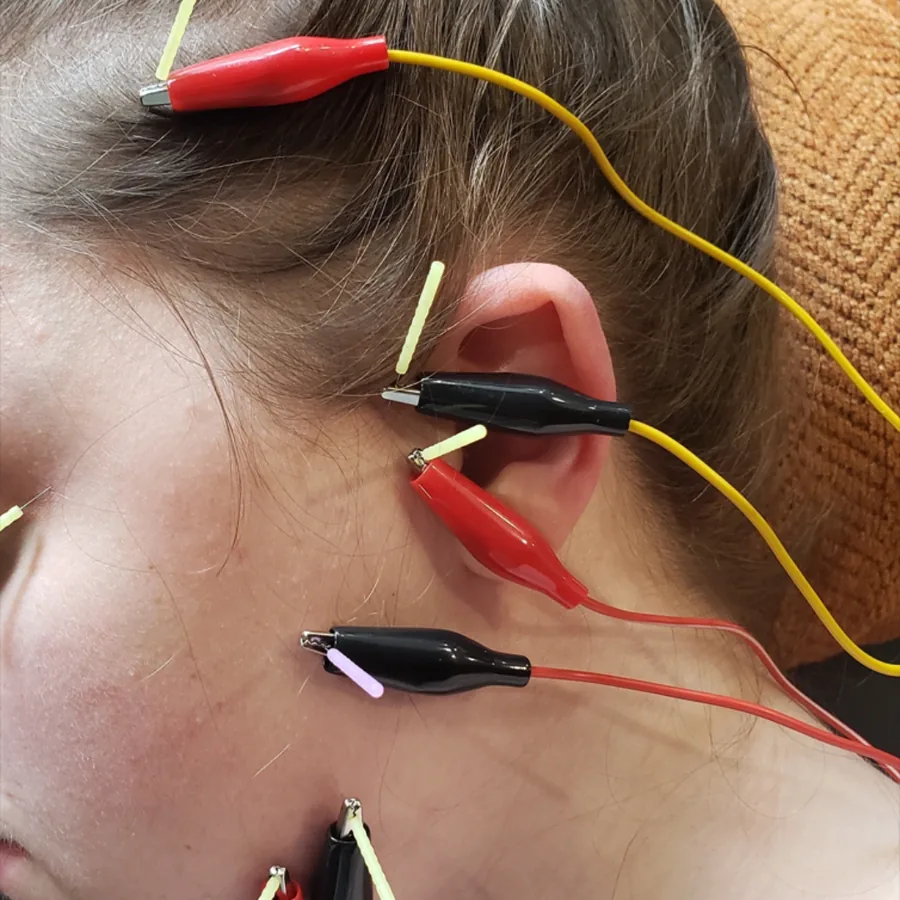
Electrical stimulation is sometimes attached to the needles. That changes the sensation to a rhythmic pulsing rather than a twitch, and most people find it considerably more comfortable than they expect. It is not always appropriate, and it is never the default.
How it compares to things you have already felt
Compared with a deep tissue massage on a genuinely sore muscle, needling is usually less unpleasant, because a thumb has to compress everything between the surface and the target while a needle passes through it.
Compared with a cortisone injection, it is a different order of sensation entirely: no volume going in, no stretch of the tissue, no ache from the fluid afterwards.
Compared with acupuncture, it is generally more intense in the moment. Acupuncture needles are often placed superficially and left; dry needling goes for a specific muscle at depth, and the twitch response is the thing acupuncture is not usually trying to produce.
What to do in the 48 hours afterwards
Move. The single most useful thing after needling is using the muscle through its new range, which is why loading follows needling in the same session here rather than being sent home as homework.
Hydration and ordinary activity are fine. Heat tends to feel better than ice on post-needling soreness, though neither changes the outcome much. Hard training on the treated area the same day is worth avoiding, not because it is dangerous but because it makes it impossible to tell what caused what.
If the soreness is still building on day three rather than fading, that is the point to say something. It is rarely serious and it is always worth adjusting the dose for next time.
Why the first session feels different from the fourth
The first session is the most uncomfortable one for most people, and very little of that is about the needle. It is the first time, the muscle is at its most guarded, and nobody has yet learned how you respond.
By the second or third session two things have changed. The tissue is less irritable, so the same input produces less protest. And the dose is calibrated to you rather than to a starting assumption — more points where you tolerate them, fewer where you do not, different depth, different dwell time.
People routinely tell me the third session was the one where they stopped bracing. That is not a coincidence and it is not toughness. It is knowing what is coming, which turns out to be most of the discomfort.
If it is going the other way — if session three is worse than session one — that is not a tolerance problem to push through. It usually means the diagnosis needs revisiting, and it is a conversation, not a reason to try harder.
Who should not have it
Needling is not for everybody, and the screening matters more than the technique. An active infection over the area, a genuine needle phobia that no amount of explanation settles, and lymphedema in the limb are all reasons to use something else.
Blood thinners are not an automatic no, but they change the conversation and the sites chosen. Pregnancy restricts certain areas. An implanted device changes what can be done nearby. All of that is covered before anything is opened.
And if the examination says the problem is not muscular in the first place, needling is the wrong tool no matter how comfortable it would have been. That is the more common reason not to do it.