The short answer
Arthritis is not a reason to stop moving. Arthritic changes appear on scans of plenty of people who have no pain at all, and joints are maintained by load rather than damaged by it. Strength around the joint is what reliably reduces arthritic pain.
- Arthritic changes on imaging are common in pain-free people; the scan is not the whole story.
- Capacity around the joint is the most trainable variable and it is trainable at any age.
- Protection reduces capacity, which makes more activities hurt — the spiral compounds.
- BFR allows real strength gains at loads an irritable joint can tolerate.
“I'm old, I'm supposed to hurt.” I hear that sentence most weeks, usually from somebody in their fifties who has quietly stopped doing three things they used to enjoy.
Pain does not simply show up with age. It is the result of injuries, muscle and skeletal misuse over time. Movement caused the pain to appear, and correct movement and coaching can help it go away.
What the scan does and does not tell you
Arthritic changes are extremely common in people with no pain whatsoever. Imaging findings and symptoms correlate far more loosely than most people are led to believe, which means a report describing degeneration does not, on its own, explain why your knee hurts on Tuesdays.
That is genuinely good news, because it means the joint surface is not the only variable in the equation. And it is not the one we have the most leverage over.
What consistently separates a comfortable arthritic joint from a painful one is capacity: the strength, control and load tolerance of the muscle around it. Capacity is trainable at essentially any age.
The protection trap
Here is how the spiral usually runs. The joint hurts, so you protect it. Protection reduces load, which reduces capacity. Lower capacity means ordinary activities now sit closer to your limit, so more things hurt. So you protect more.
Nothing about that spiral is irrational — every individual step is a sensible response to pain. It just compounds in the wrong direction, and after two or three years the difference between what you can do and what you would like to do has become substantial.
Breaking the spiral does not require heroics. It requires load that the joint can tolerate today, applied consistently.
The load problem, and the way around it
The bind with an arthritic knee or hip is obvious once you name it: strengthening needs meaningful load, and meaningful load is what flares the joint.
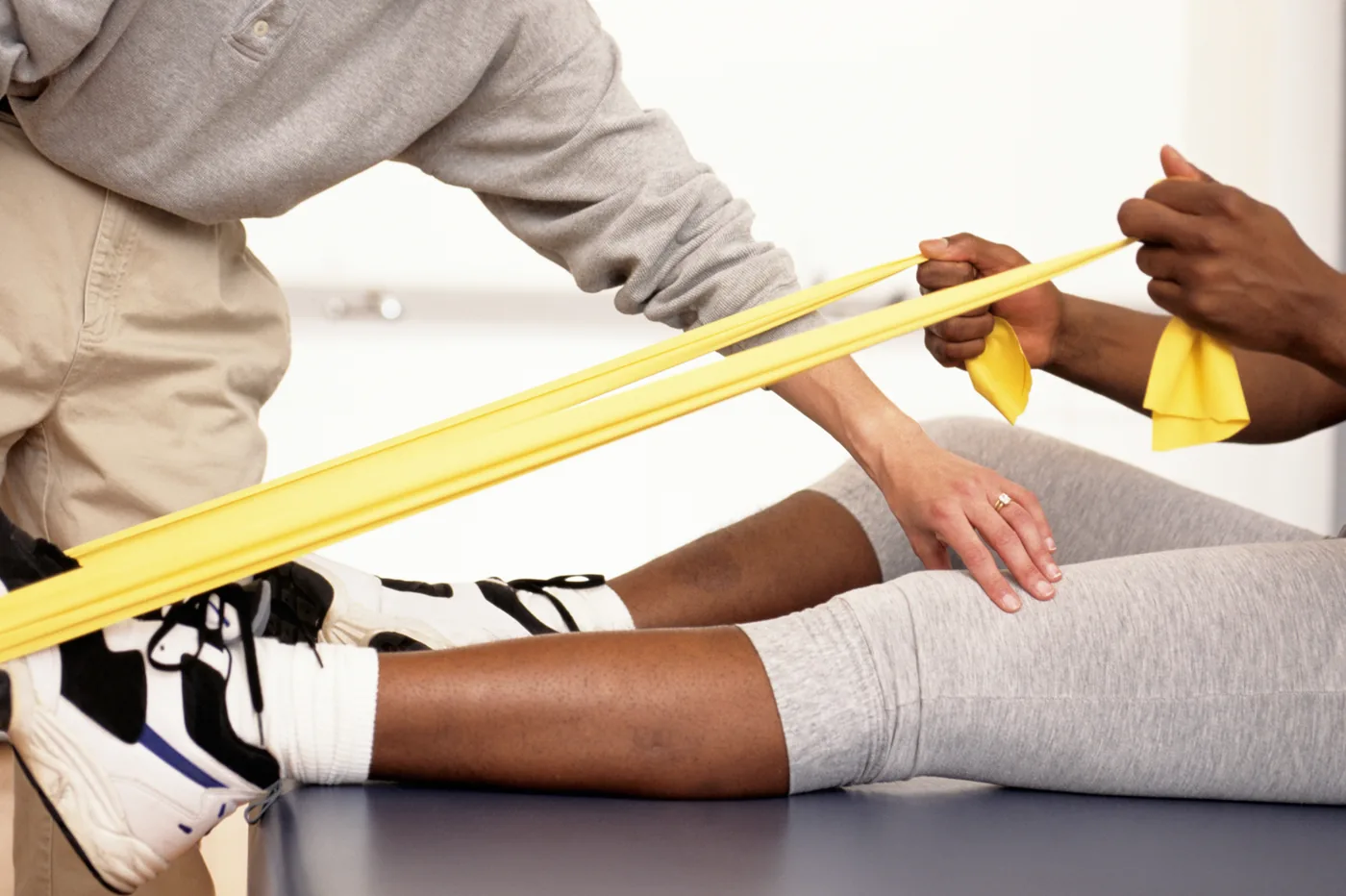
Blood flow restriction therapy resolves that directly. By restricting blood flow out of the working muscle during light exercise, it produces strength and muscle size adaptations at loads well below what conventional strength training requires. Effects normally seen after 12 to 16 weeks of traditional strengthening can be observed as soon as 2 weeks.
For somebody who has been told to strengthen a knee that hurts every time they try, that is not a marginal improvement. It is the difference between a plan that works and a plan that gets abandoned in week two.
What else helps
Manual therapy and manipulation reduce stiffness and the guarding that builds around a joint that has been protected for years. Cupping and instrument-assisted soft tissue work address the surrounding restriction, which is often a bigger contributor to how stiff you feel in the morning than the joint itself.
Osteopractic therapy can greatly help provide much needed relief from the symptoms of arthritis while also improving your movement quality, making it easier to do everyday activities. Those two things reinforce each other — less pain makes movement possible, and better movement reduces pain.
“My only option is surgery”
Sometimes it genuinely is, and that is a conversation between you and your surgeon.
But a lot of people arrive at that conclusion having never had a proper loading program, and a proper loading program changes what daily life feels like more often than they expect. Whatever you decide, arriving at surgery with more strength and better movement makes the recovery on the other side markedly easier. There is no version of this where capacity is wasted effort.
What arthroscopy does and does not do
Arthroscopic surgery for degenerative knee disease, including partial meniscectomy for degenerative tears, has been compared with placebo surgery and with exercise in several trials.
It has generally not outperformed either, and multiple guidelines now recommend against it for that indication.
A degenerative meniscal tear on a scan of a fifty-five-year-old knee is a common finding and frequently incidental.
The exception is a genuinely locked knee that cannot straighten, which is a mechanical problem and a surgical question.
Morning stiffness, and what it tells you
Stiffness for fifteen to thirty minutes on waking, easing with movement, is typical of osteoarthritis and is not a sign of deterioration.
Stiffness lasting more than an hour, particularly in someone under forty-five, with pain that improves with exercise and worsens with rest, points toward an inflammatory condition and belongs with a physician.
Several small joints involved symmetrically, swelling in the hands, fatigue and unwellness point the same way.
That distinction is worth being clear about, because the two conditions need different medical management even though both benefit from exercise.
Braces, insoles and injections, briefly
Unloader braces for single-compartment disease have modest evidence and help some people for specific activities. Simple sleeves are comfortable and do not change the disease.
Lateral wedge insoles have been studied extensively and have not held up.
Corticosteroid injection helps during a flare with swelling; repeated injections into the same joint are worth avoiding.
All of these are reasonable adjuncts for somebody who is also loading the leg, and none of them substitute for it.
What to expect over years
Not everybody progresses. A substantial proportion of people with radiographic osteoarthritis remain stable or improve symptomatically over a period of years.
Function is far more modifiable than structure, and function is what determines whether you can do what you want.
Many people who commit to strengthening delay or avoid a replacement altogether, and those who do eventually have one recover better for having stronger legs going in.
So the work is not wasted in either scenario, which is an unusually good position to be able to describe honestly.
Walking, cycling and what is safe
Walking is safe and beneficial, and the fear that it accelerates wear does not hold up. Inactivity is associated with worse outcomes, not better ones.
Cycling loads the joint through range with relatively low compression, which makes it a good option when walking distances are hard.
Water-based exercise is useful during a flare and is a poor strength stimulus, because the water removes the load that produces adaptation.
Running is not automatically off the table either. Recreational running has not been shown to cause osteoarthritis, and a proportion of people with it continue comfortably.
What the guidelines actually say
Exercise and education are first-line treatment for knee and hip osteoarthritis in every major clinical guideline, ahead of medication and well ahead of surgery.
The pain relief from a properly conducted exercise program is comparable in size to that of common anti-inflammatory medication, without the risks that come with taking those for years.
The effect holds regardless of how severe the changes look on an X-ray, which is why radiographic severity is not a reason to exclude someone from trying.
None of that is controversial or new. The gap is between what the guidelines say and what people are told in the room.
How much pain is acceptable while you exercise
Up to about five out of ten during the session, settling within twenty-four hours, is the standard guidance and it is well tolerated in practice.
A joint that is more swollen or more painful the next morning had too much. Reduce the load about ten percent rather than stopping altogether.
The instinct to stop at the first discomfort is what leaves people a little weaker every year, and that decline is what eventually limits them rather than the arthritis itself.
Most people find the first two weeks are the hardest and that symptoms during exercise settle well before symptoms during daily life do.
Flares, and how to handle one
More pain, sometimes visible swelling, a joint that feels hot and stiff. Usually it follows an unaccustomed load and sometimes nothing identifiable at all.
Reduce the load, keep the frequency. Isometric work is well tolerated during a flare and keeps the muscle switched on when everything else is uncomfortable.
Simple analgesia, ice or heat if either helps, and a return to the program as things settle, which is usually a week or two.
Flares are part of the condition. Treating every one as evidence of deterioration and permanently reducing activity afterward is what produces the long decline.
What else moves the needle
Weight, where it is relevant, because a loss of around five to ten percent of body weight produces meaningful symptom change for many people through both mechanical and metabolic routes.
Sleep, which affects pain thresholds directly and is consistently underrated.
General activity, because the cardiovascular and metabolic benefits matter independently of the joint.
And accurate information, because people who believe their joint is wearing out with every step behave differently from people who know that loading is what keeps cartilage and muscle healthy.
Start here
- Pick the two activities you have quietly stopped doing. Those are the goals.
- Expect a settling period. Some day-after stiffness when you start loading is normal and not damage.
- Consistency beats intensity every time with an arthritic joint.
- Get a hot, red, acutely swollen joint or joint pain with fever seen by a physician — that is not this.