The short answer
Blood flow restriction training builds strength and muscle size using about 20–30% of the load normally required. A cuff limits blood leaving the working muscle, which produces a strong training signal at a weight an irritable or post-operative joint can actually tolerate.
- BFR builds strength and muscle size at loads an irritable joint can actually tolerate.
- Effects normally taking 12–16 weeks of standard strengthening can appear in as little as two weeks.
- It also supports aerobic capacity and recovery for healthy athletes.
- Screening comes first — certain vascular and cardiac histories rule it out.
There is a problem at the center of almost every rehabilitation plan, and most people never hear it stated out loud. To get stronger, muscle needs meaningful load. But the joint or tendon we are trying to protect frequently cannot tolerate meaningful load. So the plan quietly settles for light exercise that keeps you comfortable and does not make you stronger.
Blood flow restriction training is the way out of that bind, and it is one of the reasons people travel to see me.
What BFR actually is
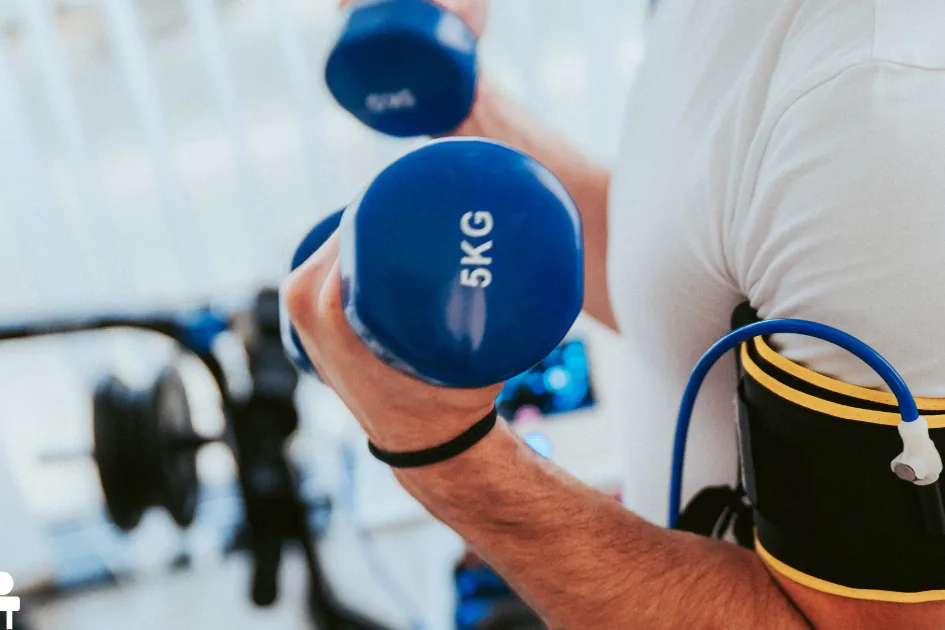
A tourniquet cuff is placed around the top of a limb and inflated to a set pressure during exercise. It restricts blood flow out of the working muscle. That is it — no drugs, no devices inside you, no exotic equipment beyond the cuff itself.
The reduced oxygen supply makes the muscle fatigue and work far harder than the weight in your hand would suggest. That triggers a cascade of physiological effects: an increase in muscle strength and size at low loads, tissue regeneration, the release of growth hormone, and support for bone healing.
The number that gets everyone's attention: treatment effects normally seen after 12 to 16 weeks of traditional strengthening exercise can be observed as soon as 2 weeks with BFR.
Why that matters after surgery
The weeks after a knee or shoulder operation are when you lose the most muscle and can do the least about it. Conventional strengthening requires loads the healing tissue is nowhere near ready for, so most post-operative programs spend six weeks treading water.
BFR lets you train hard at weights the repair can handle. You are not choosing between protecting the surgery and keeping your quadriceps — which is exactly the choice most people are quietly forced into.
The same logic applies to an arthritic knee, a healing fracture, a tendon in an irritable phase, or any joint where the strength you need and the load you can tolerate are pointing in opposite directions.
It is not only a rehab tool
BFR improves fitness when combined with aerobic or high-intensity interval training. It can improve VO₂ max and aerobic capacity, and it is a strong option for muscle recovery.
For an athlete inside a heavy competition block, that is valuable: a way to keep a strength stimulus without adding the systemic fatigue of a heavy session two days before you compete.
What a set feels like
Uncomfortable. Honestly, that is the fair description. A light weight starts to burn surprisingly early, and the last few repetitions of a set feel much harder than the load justifies. That burning fatigue is the mechanism working.
What it should not feel like is sharp pain, numbness, or pins and needles. Say so immediately if it does. The cuff comes off between exercises, and pressure is set to you and the limb being trained rather than to a fixed number applied to every client.
Who should not do it
BFR requires screening, and it is not for everyone. A history of blood clots, certain vascular or cardiac conditions, uncontrolled hypertension, active infection in the limb, and some other presentations rule it out.
That screening happens before a cuff goes anywhere near you. If your history says no, I will tell you no and we build the plan another way — there is always another way.
What it does not replace
It does not replace heavy loading once heavy loading is possible, and any plan that keeps someone on restricted low loads for months is using it as a destination rather than a bridge.
It does not replace range of motion work, gait retraining, or the specific tasks you are trying to get back to.
And it does not shorten tissue healing timelines. A repaired tendon heals on its own schedule regardless of how well the surrounding muscle is trained.
What it does is stop the muscle wasting while the timeline runs, which turns out to matter a great deal at the twelve-month mark.
How it fits with everything else in a session
Usually in the middle: after whatever manual work has made the joint comfortable, before the range and gait work that finishes the session.
It does not replace conventional loading for the parts of you that can tolerate it, so the uninjured side and the rest of the limb train normally throughout.
It also does not preclude cardiovascular work, which most people can continue in some form and which matters more during a layoff than at any other time.
The aim across a whole plan is that the restricted portion shrinks as tolerance grows, until it is no longer needed.
Screening before the cuff goes on
A history covering clotting disorders, previous deep vein thrombosis or pulmonary embolism, cardiovascular disease, uncontrolled hypertension, and pregnancy.
Cancer history, vascular grafts, and anything affecting the circulation in that limb.
Sickle cell trait and certain medications also change the conversation.
None of that is a formality, and it is why blood flow restriction belongs with somebody trained in it rather than with a strap bought online and applied on the strength of a video.
What a typical block looks like
Four exercises, twice a week, for six to eight weeks, with the restricted portion lasting well under fifteen minutes per session.
Load starts around twenty to thirty percent of what you could lift once, which feels almost embarrassingly light for the first set and considerably less so by the fourth.
Sets are longer than usual — commonly thirty repetitions then three sets of fifteen, with short rests and the cuff staying inflated between them.
Progress is measured the same way as any strength program: girth, measured strength, and what the limb can do.
Who tends to benefit most
Anyone whose joint cannot yet tolerate the load that produces strength adaptation — early after surgery, during an arthritic flare, or in a painful tendon.
Older adults, for whom heavy loading is often unappealing or impractical and for whom muscle loss carries real consequences.
Athletes in a period where one limb is restricted and the rest of the body is still training.
And people who have already lost noticeable size on one side, where the gap between limbs is the thing being closed.
What the research supports
Low-load training with blood flow restriction produces strength and hypertrophy comparable to conventional heavy resistance training in a range of populations, and it does so at loads most rehabilitating joints tolerate.
The effect has been shown after knee surgery, in older adults, and in athletes returning from injury, which covers most of the situations where it gets used here.
It is not magic and it is not a replacement for heavy lifting once heavy lifting is possible. It is a way of not losing three months while you wait to tolerate it.
The mechanisms are still being worked out — metabolic stress, cell swelling and greater recruitment of fast-twitch fibers are all implicated — and the practical point stands regardless of which turns out to dominate.
How the pressure is decided
Not by feel, and not by a fixed number. The cuff is inflated to a percentage of the pressure at which arterial flow into the limb stops, and that pressure differs between people and between limbs.
Measuring it individually is what separates a proper application from a strap tightened until it seems about right.
Cuff width matters too, because a wider cuff occludes at a lower pressure.
This is the main reason the equipment costs what it does and the main reason the internet version is not the same thing.
What it feels like the day after
Sore, in the ordinary way, often more than the light weight would suggest. That is expected and it settles like any training soreness.
Some people notice the limb feels heavy for an hour or two afterward.
What should not happen is numbness, tingling that persists, or discoloration that does not resolve within minutes of the cuff coming off. Any of those is a reason to stop and reassess the setup.
Sessions are short — usually under fifteen minutes for the restricted portion — which surprises people expecting something more arduous.
How I use it in a plan
Rarely on its own. BFR is a bridge across the gap between what your tissue can tolerate today and what conventional strength training will demand of it in six weeks.
So a typical progression looks like: settle the irritation with manual therapy and needling; build capacity with BFR while the joint is still sensitive; transition to conventional loading as tolerance improves; then finish the job with the strength work you needed all along. The cuff comes out of the bag less and less as the weeks go on. That is the point.