The short answer
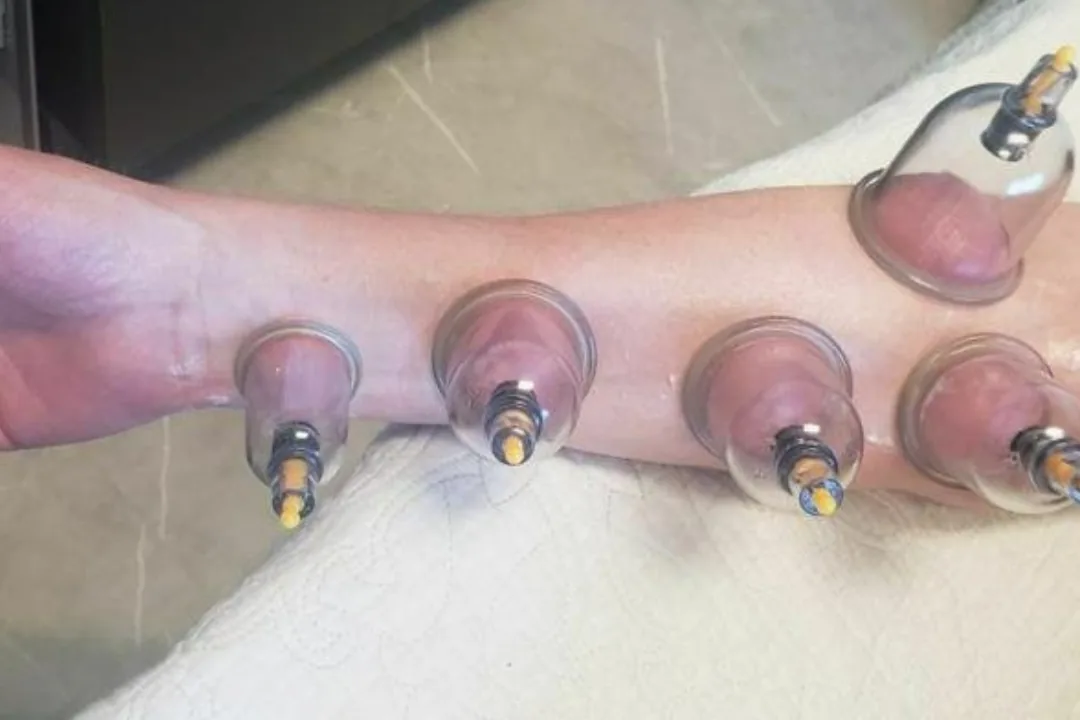
Cupping marks are not bruises. A bruise is bleeding caused by impact; cupping marks are blood drawn toward the surface by suction, with no impact and no tissue damage. They usually fade in three to seven days and their darkness does not measure how well it worked.
- Cupping decompresses tissue; almost every other manual technique compresses it.
- The marks are drawn-up stagnation, not impact bruising or tissue damage.
- They fade in a few days to a few weeks and vary a lot between people.
- Tell your therapist about upcoming events so placement can be adjusted.
Somebody always asks. Usually a colleague, occasionally a stranger at the pool, and the tone is always the same — concern. The circles look dramatic. They are also the most misunderstood thing in my treatment bag.
What cupping does to tissue
Nearly every manual therapy technique compresses. Massage presses in. Foam rolling presses in. A thumb in a trigger point presses in.
Cupping does the opposite. Air is drawn out of a plastic cup to create a vacuum that pulls up the skin, muscle and fascia. It decompresses the tissue, and that lift reaches restrictions compression keeps skating over.
That decompression improves circulation and healing and brings oxygen and nutrients into the area. It also helps clear lactic acid and metabolic waste from muscles you have worked hard, which is why it is such a useful recovery tool after heavy training.
So what are the marks?
The suction draws stagnant blood and fluid from the deeper tissue toward the surface. What you see afterwards is that material sitting in the superficial layers where the body can clear it.
That is a fundamentally different thing from a bruise. A bruise is bleeding caused by impact trauma. A cupping mark is drawn-up stagnation with no impact and no tissue damage involved.
Practitioners will tell you darker marks indicate more stagnation in the area. Treat that as a rough observation rather than a diagnostic instrument — skin type, hydration and how long the cup sat all affect the color too.
How long they last
Anywhere from a few days to a few weeks, depending on the client. There is genuine person-to-person variation and it is not something you can predict reliably in advance.
If you have a wedding, a photo shoot or a beach holiday coming up, tell me before the session rather than after. Placement can be adjusted, suction reduced, or cupping left out of that particular week entirely. It is not worth being self-conscious for two weeks over.
Who benefits
You will benefit from cupping if any daily or recreational movement causes you pain, or if you exercise regularly and keep meeting the same tight spots. The classic candidates are a stiff upper back and shoulders, chronically tight calves, IT bands that never seem to change no matter how much you roll them, and scar tissue restriction after surgery.
It is also excellent on tissue that has been protected for a long time. Areas around a joint you have been guarding for years accumulate restriction that responds well to being lifted rather than pressed.
What the cup is actually doing to tissue
Negative pressure lifts the skin and the layers beneath it, which is the opposite of the compression almost every other manual technique applies.
That lift decompresses the tissue planes and appears to change local circulation, which is the most likely explanation for the immediate change in how an area moves.
It also produces a strong sensory input, and a proportion of the effect is almost certainly neurological rather than mechanical — which is true of most manual therapy and is not a criticism.
The visible marks are a consequence of that pressure differential rather than the point of it.
Dry cupping and wet cupping are not the same thing
What happens here is dry cupping: suction only, no skin broken, nothing removed.
Wet cupping involves making small superficial incisions and drawing a small amount of blood. It is a different procedure with a different risk profile and it is not offered here.
The distinction matters because the two are frequently discussed together and people arrive expecting one and worrying about the other.
If someone offers you cupping, it is worth asking which they mean, and what their training in it consists of.
The bruising question, answered once
A bruise is bleeding from vessels torn by impact. It hurts to press, changes color through a predictable sequence, and follows an injury.
A cupping mark is blood drawn toward the surface by negative pressure without any tissue being damaged. It is generally not tender, and it fades more evenly.
That is why a heavily marked back is usually comfortable to touch immediately afterward, which surprises people looking at it in a mirror.
If an area is genuinely painful to press for several days afterward, that is worth mentioning rather than assuming it is part of the process.
The short version, for anyone who has just seen their own back: the marks look considerably more alarming than they feel, they are not damage, and they will be gone inside a week or two.
What to expect over a course of treatment
Most people who respond notice a change within the first session or two, and that change is usually in how the area moves rather than in the pain score.
The marks become less pronounced with repeated treatment of the same area, which is normal and is not evidence of diminishing benefit.
It is used less as the plan progresses, because the loading takes over and there is less guarding to address.
By discharge it should have disappeared from the sessions entirely, which is the sign the plan worked rather than the sign something was withdrawn.
Why the marks vary so much between people
The same suction on two people produces very different marks, and the difference does not track with how much pain either of them is in.
Areas that have not been treated before tend to mark more, and the same area marks less on subsequent visits, which people notice and reasonably wonder about.
Skin tone, medications, hydration and local circulation all affect the appearance.
So the mark is not a score. Reading it as a measure of how bad your muscle is, or how effective the treatment was, is a misreading that the internet has done a great deal to encourage.
Where it fits alongside everything else
Usually as an opener: a few minutes on an area that is guarding, followed immediately by the movement or loading that the session was actually about.
It combines well with needling and with manipulation, and there is no particular reason to choose between them when the examination supports more than one.
It is not something to book a course of on its own.
And if a session of it produces no change in how you move, it is not the right tool for you, which is worth establishing in one visit rather than six.
What the evidence supports, honestly
Cupping has modest evidence for short-term pain reduction, mostly in neck and back pain, and the studies are generally small and difficult to blind convincingly.
It sits in the same category as several manual techniques: it changes symptoms in the short term for a good proportion of people, and it does not build capacity.
That is a reasonable thing for a treatment to do, provided it is described accurately and used as an adjunct.
I use it where it demonstrably helps a particular person move better, and not as a routine applied to everybody who walks in.
What it feels like
A strong pulling sensation rather than pressure, which is the opposite of most manual therapy and takes a moment to get used to.
It should not be sharp or burning. If it is, the cup comes off.
Most people find it comfortable and a proportion find it oddly pleasant, which is consistent with what it does to local tissue.
Sessions are short, usually a few minutes per area, and are followed immediately by movement rather than by rest.
Aftercare and who should avoid it
Keep the area covered for a few hours, avoid a very hot shower or a sauna immediately afterward, and drink normally.
The marks are not a wound and need nothing applied to them.
Cupping is avoided over broken skin, over an active skin condition, over a recent injury with swelling, and in people taking anticoagulants or with bleeding disorders without a specific conversation first.
It is also avoided over areas of reduced sensation, and modified in pregnancy. As with everything else here, none of that rules out treatment — it changes which tool is used.
Cups plus movement
Static cups do useful work. Cups combined with movement do more.
If I have you move through range with the cups in place, the fascia glides while it is decompressed, and the tissue learns a new relationship rather than simply visiting one. That is the difference between a restriction that stays gone and one that is back on Thursday.
As with everything else in this practice, cupping is a tool inside a plan. Tissue that is freed and then never loaded goes back to being stiff tissue. Freed, then loaded, is what makes it stick.