
The short answer
Massage compresses tissue; cupping decompresses it. Almost every manual technique pushes down into the tissue, while cupping lifts skin, fascia and superficial muscle away from what is underneath. That makes cupping useful for areas that stay stiff no matter how much pressure has been applied to them.
- Massage compresses tissue, cupping decompresses it — they are opposites, not alternatives.
- Cupping suits broad stiffness that keeps returning and areas too irritable to press into; massage suits discrete points and broad relaxation.
- Marks are suction, not impact, and their darkness says nothing about the result.
- Both open a window; what you load inside it decides whether anything lasts.
- If the same area keeps needing the same treatment on the same timeline, the answer is an examination of why rather than another session of either one.
People generally ask which of these is better, which is the wrong question. They do mechanically opposite things, and the useful question is which direction your particular problem needs. Get that right and either one can produce a change you notice inside a single session; get it wrong and you can spend months paying for the correct technique applied in the wrong direction.
The mechanical difference, and why it matters
A thumb, an elbow, a forearm or a tool all do the same thing: they push into the tissue and compress everything between the surface and whatever you are aiming at. That is effective and it is how most manual therapy works.
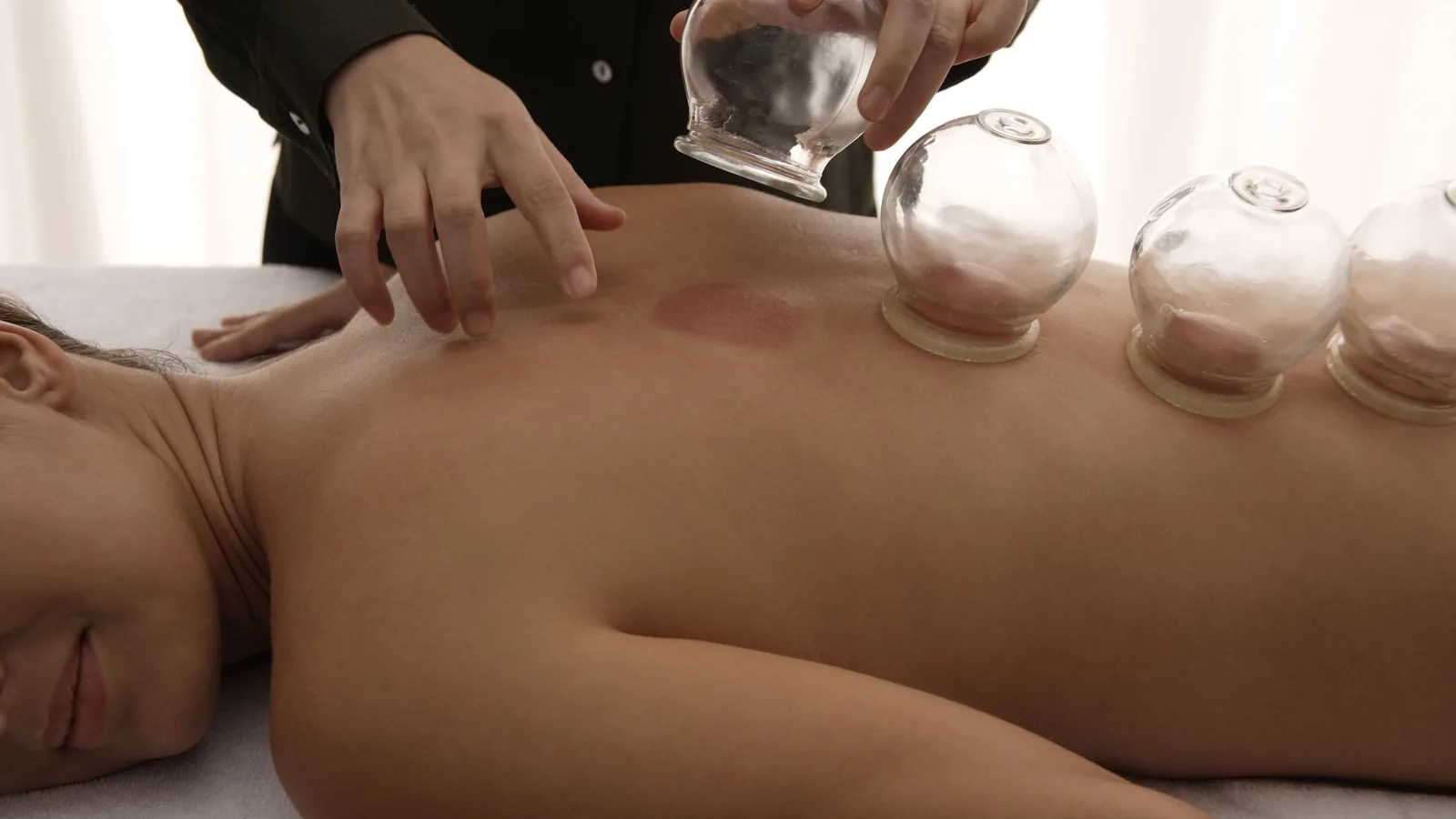
A cup does the reverse. Negative pressure lifts skin, fascia and the superficial layer of muscle upward, creating space between layers that normally slide against each other.
That distinction is not academic. Tissue that has become adherent — layers that are not gliding — often responds poorly to more compression and well to being separated. Which is why cupping frequently helps in exactly the places where massage has stopped producing lasting change.
What massage is genuinely better at
Broad relaxation, for one. Thirty minutes of sustained compressive work has an effect on the nervous system that a cup does not replicate, and for somebody carrying general tension that is worth having.
Specific trigger point work with sustained pressure, where the goal is to hold a point until it releases. Deep work on large muscle bellies. Anything where the target is well within reach of a thumb.
And circulation-focused work over large areas, which is simply faster by hand than by moving cups around.
What cupping is better at
Areas that stay restricted despite pressure. The upper back, the IT band and lateral thigh, the thoracolumbar fascia, the calf — regions where the complaint is stiffness that returns rather than a discrete sore spot.
Scar tissue and post-surgical restriction, where compression is uncomfortable or contraindicated and lifting the tissue is better tolerated.
Anywhere the tissue is too irritable to be pressed into. A cup can produce a meaningful change without the discomfort of digging into an area that is already angry.
The marks, briefly
Cupping marks are not bruises. A bruise comes from impact damaging vessels; cupping marks come from blood drawn toward the surface by suction, without impact and without tissue damage.
They typically last three to seven days. Their darkness varies enormously between people and between areas on the same person, and it is not a measure of how well the session worked.
Massage does not usually mark, which is the main practical reason people choose it before an event. That is a legitimate reason and it is worth saying rather than working around.
Static, sliding and with movement
Static cupping leaves the cup in place for several minutes. That suits a specific restricted area and produces the most marking.
Sliding cupping moves the cup across the tissue with a lubricant, covering a broader region with less time in any one spot. It is closer in feel to a firm massage stroke, and it marks less.
Cupping with movement — cups applied while you actively move the limb — is the version most people have never had and the one that produces the most durable change here, because it combines the decompression with the loading that makes it hold.
Why neither one is a treatment on its own
Both are inputs. They change how the tissue feels and how much it will let you move, and both effects are temporary if nothing else changes.
Tissue that keeps tightening is usually tightening for a reason: a joint that is not moving, a muscle group that cannot support the load being asked of it, or a daily position that reloads the same structure for eight hours.
So the question after either technique is the same. What was done with the extra range? A plan that consists of coming back every week for more soft tissue work is treating the symptom on a schedule.
How to tell which one you need
If pressing on the area feels good and produces relief, compression-based work is probably reaching the problem. If pressing on it makes it worse, or produces nothing, that is a reason to try the other direction.
If the complaint is a discrete point you can put a finger on, that suits massage or needling. If it is a broad band of stiffness that returns predictably, that suits cupping.
If it has been treated repeatedly with the same technique and keeps coming back on the same timeline, the answer is probably neither technique but an examination of why.
Using both, and in what order
They combine well. A common sequence here is cupping to decompress and improve glide, then specific work into what that exposes, then loading.
The order matters more than people expect. Decompressing first often makes the specific work more comfortable and more effective, because the layers are moving before anything is pressed into them.
What does not work well is alternating between practitioners doing the same generic soft tissue work on the same area indefinitely. Two people compressing the same tissue in different rooms is not a plan.
What to expect afterwards
Looseness immediately, often more than expected. Mild soreness the following day in the treated area, similar to after a workout.
Marks appear within minutes and darken slightly over the first day before fading. They do not hurt to touch in the way a bruise does — if they do, that is worth mentioning.
Keep the area warm and keep moving. Both techniques buy a window; both windows close if nothing is done inside them.
Who should avoid each
Cupping is avoided over broken skin, active infection, recent surgical sites before they have healed, and areas of deep vein thrombosis risk. It is used cautiously with blood thinners and on very thin or fragile skin.
Massage has a shorter list but the same principles: not over an acute injury with suspected fracture, not over infection, and cautiously where sensation is impaired.
Both require the same screening question first — is this actually a soft tissue problem? If the examination says the driver is a joint, a nerve or a capacity deficit, the most skillful soft tissue work in Dallas will still be treating the wrong thing.
Where the confusion usually comes from
Cupping arrived in most people’s awareness through photographs of athletes with circular marks, which framed it as a recovery fashion rather than a manual technique with a specific mechanical purpose.
It also carries a traditional-medicine history that sits uncomfortably alongside its use in orthopedic practice, in much the same way dry needling is confused with acupuncture. The tool is shared; the reasoning is not.
In this practice cupping is used for one reason: to lift and separate tissue layers that are not gliding. Nothing about meridians, nothing about drawing out toxins, and no claim about anything beyond the tissue directly under the cup.
That narrower claim is easier to test and easier to abandon when it is not working, which is the point.
What this looks like in a session here
Cupping is rarely the whole appointment and never the whole plan. It is used where the examination says tissue glide is part of the problem, usually for ten to fifteen minutes, followed immediately by movement through the range it opened up.
That is the difference between a treatment and a therapy appointment. The cups are not the point; what you can do afterwards is.
If you want purely relaxation-focused massage, that is a legitimate thing to want and there are excellent people in Dallas who do it well. It is a different service and it is worth being clear which one you are booking.
A note for people who bruise easily
If you mark heavily from ordinary knocks, you will mark heavily from cupping, and that is worth planning around rather than discovering afterwards.
Shorter dwell times, lower suction and sliding rather than static cupping all reduce marking considerably, and none of them make the technique meaningfully less effective for most problems.
Areas matter too. The upper back marks readily; the calf and forearm usually do not. If visible marks are a problem for your work, that shapes where the technique gets used, and the plan adapts without argument.

