The short answer
Jaw dysfunction produces headache mainly through the temporalis and masseter muscles, which refer pain into the temple, behind the eye and along the teeth. The upper neck shares a relay station with the nerve supplying the jaw, so neck and jaw problems reinforce each other and are usually treated together.
- Temporalis and masseter refer pain into the temple, eye and teeth — the classic jaw-driven headache.
- The upper neck and the jaw share a relay in the brainstem, so they are assessed and treated together.
- Painless clicking is common and usually needs nothing; pain, restricted opening or locking does.
- A night guard protects teeth from grinding but does not stop the grinding, and resting teeth apart does more than any exercise.
The temporomandibular joint gets treated as a dental problem, and sometimes it is. Rather more often it is a muscular and postural problem that a dentist and a physical therapist should be looking at together.
What the joint does
The temporomandibular joint is one of the busiest joints in the body. It moves every time you talk, eat, swallow or yawn, which is a few thousand times a day.
It hinges and it slides, which is unusual, and a small disc sits between the surfaces to manage that combination.
Both sides work together whether you like it or not, so a problem on one side changes the mechanics on the other.
Where the headache comes from
Temporalis, the fan-shaped muscle over the temple, refers pain into the temple, behind the eye, and into the upper teeth. That referral pattern is the classic temple headache.
Masseter, the thick muscle at the angle of the jaw, refers into the cheek, the ear, the lower teeth and the jaw itself. Patients frequently arrive having already seen a dentist about a tooth that turns out to be healthy.
Both are clenching muscles. Both become tender and taut when clenching is habitual.
Clenching, which most people deny
Daytime clenching is largely unconscious and enormously common under stress or concentration. People discover it when they are asked to notice, not before.
Night-time grinding is separate, more forceful, and often reported by a partner rather than the grinder. Waking with a tight jaw or a dull temple ache is the usual clue.
The resting position of the jaw should be teeth apart, lips together, tongue resting on the palate. Most people with jaw pain are resting with teeth in contact, which means the muscles never fully switch off.
Why the neck is always in the conversation
The trigeminal nerve supplies the jaw and face, and its relay in the brainstem receives input from the upper three cervical nerves as well. The two streams converge.
So an irritated upper cervical joint can produce facial and jaw symptoms, and jaw dysfunction can amplify neck-related headache. The traffic runs both ways.
Practically, this means an assessment that only examines the jaw is incomplete. In my experience the upper neck is involved in the clear majority of jaw cases, and treating it changes the jaw.
Clicking, and whether it matters
A jaw that clicks without pain and opens fully is extremely common and generally does not need treating. Population studies find clicking in a large minority of people with no complaint at all.
Clicking with pain, or with limited opening, or with a jaw that deviates markedly to one side as it opens, is a different matter and warrants assessment.
The concerning presentation is a jaw that locks — either unable to open past about twenty-five millimetres, or unable to close after opening wide. That needs seeing promptly.
How opening is measured
With a ruler, between the front teeth. Normal opening is roughly forty to fifty millimetres, or about three of your own fingers stacked vertically.
Under about thirty-five millimetres counts as restricted. Under twenty-five suggests the disc is obstructing rather than the muscles limiting.
Watching the path of opening matters as much as the distance. A jaw that swings off to one side and comes back is telling you which side is restricted.
What treatment involves
Manual therapy to the jaw muscles, including work inside the mouth with a gloved hand for the medial and lateral pterygoids, which cannot be reached otherwise and are frequently the most tender structures present.
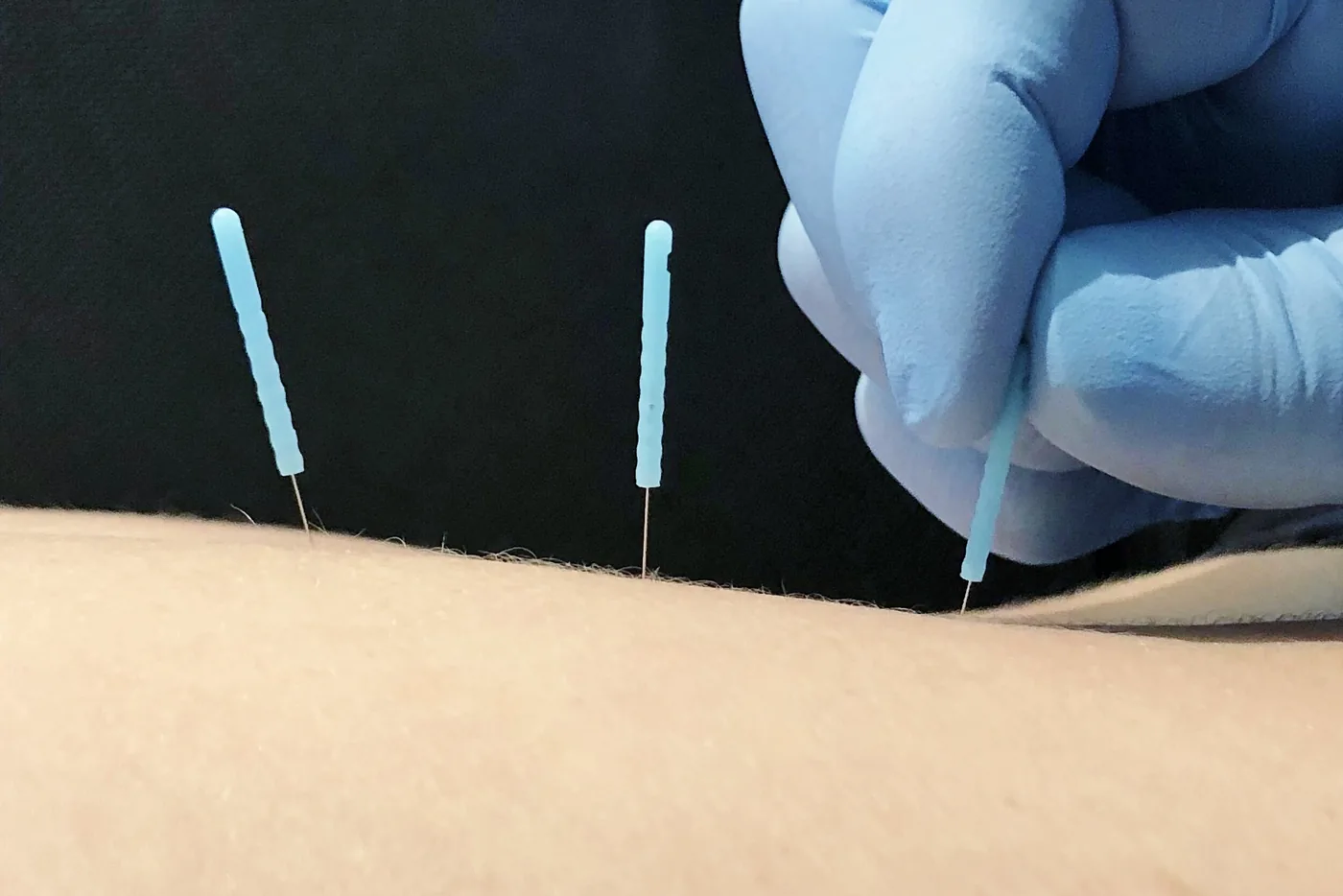
Dry needling into masseter and temporalis where they reproduce the familiar headache. This is often the fastest single change, and it is uncomfortable for about ten seconds.
Upper cervical mobilization or manipulation, because of the convergence already described.
Then motor control work: controlled opening without deviation, tongue position, and the deep neck flexor work that supports the whole arrangement.
What you do between sessions
Teeth apart. That single instruction, applied a hundred times a day, does more than any exercise. Most people need a reminder system for the first two weeks — a sticker on the monitor works as well as anything.
Soft diet during a flare. Not forever, but chewing steak and bagels through an irritable joint prolongs things.
Avoid gum entirely while symptomatic. Avoid opening wide — support the chin when you yawn.
Heat over the masseter and temporalis for ten minutes in the evening, which is unglamorous and effective.
The dentist's part
A night guard protects the teeth from grinding, which is worth having if you grind, and it does not stop the grinding. That distinction matters and it is often lost.
Bite issues genuinely exist and occasionally drive the problem. They are less often the cause than the historical dental literature suggested, and irreversible bite alteration is not a first-line treatment for jaw pain.
Where a tooth problem is possible — pain on biting a specific tooth, sensitivity to hot or cold, swelling — that goes to a dentist first. Muscle referral mimics toothache convincingly, but so does an actual infected tooth.
What a first jaw appointment involves
Measuring opening with a ruler, watching the path of the jaw as it opens and closes, and testing how it moves side to side. All of that takes about five minutes and gives numbers worth re-testing later.
Palpating temporalis, masseter and the accessible part of the pterygoids to see which of them reproduces your familiar headache. Reproduction is the finding that matters, not tenderness on its own.
Screening the upper cervical spine, including the flexion-rotation test, because the two regions are so consistently linked.
Then a conversation about clenching, sleep and what your day actually looks like, which is where most of the useful information turns up.
Exercises that are worth doing
Controlled opening: tongue resting on the palate, open slowly to the point where the jaw wants to deviate, and stop there. Ten repetitions, several times a day. The aim is a straight path, not a big range.
Resisted opening and closing with light pressure from two fingers, holding a few seconds each way, to give the muscles something to do other than clench.
Deep neck flexor work, for the reasons already covered.
What is not worth doing is aggressive jaw stretching. Forcing a restricted jaw open reliably makes it more irritable, and people arrive having spent a month proving that.
Where stress fits
Directly and mechanically. Clenching is a stress behavior, clenching loads the jaw muscles continuously, and continuously loaded muscles become painful. There is nothing mysterious about the chain.
Sleep quality affects both grinding and pain sensitivity, so it is worth addressing rather than mentioning in passing.
None of that makes the pain psychological. The muscles are genuinely working and genuinely sore.
A realistic course
Most straightforward muscular jaw pain improves noticeably within three or four sessions, with home work doing much of the lifting.
Longer-standing cases with restricted opening take longer, and the marker to watch is millimetres of opening rather than pain score, because it improves first.
Cases with true disc displacement and locking are shared care — worth treating, worth a dental or oral surgical opinion alongside.
Sleep, and the jaw at night
Side sleeping with a hand or forearm under the jaw applies hours of sideways pressure to a joint that is already irritable. It is one of the more common aggravators and one of the easiest to change.
Back sleeping avoids it entirely, which is easy to recommend and hard to adopt. A pillow arrangement that discourages rolling onto the sore side is the practical compromise.
If you wake with the jaw tight and the temples aching most mornings, that pattern points to night-time grinding and belongs in a conversation with your dentist as well as here.
When it is not the jaw
Facial pain in sharp electric bursts triggered by light touch or a breeze suggests trigeminal neuralgia, which is a neurological diagnosis and needs a physician.
Persistent ear pain, hearing change or discharge belongs with a physician too, even though jaw referral into the ear is common.
New jaw pain on chewing in someone over fifty, with headache and scalp tenderness, raises giant cell arteritis and is urgent.
And jaw or facial discomfort brought on by exertion, particularly with chest symptoms or breathlessness, is a cardiac question. That is emergency services, immediately.