The short answer
Tennis elbow affects the tendon on the outside of the elbow and hurts with resisted wrist extension and gripping. Golfer's elbow affects the inside and hurts with resisted wrist flexion and forearm rotation. The ulnar nerve runs behind the inside of the elbow, so numbness in the ring and little fingers changes the assessment.
- Outside elbow, resisted wrist extension hurts: tennis elbow. Inside elbow, resisted wrist flexion and pronation hurt: golfer's elbow.
- The ulnar nerve sits beside the medial tendon, so numbness in the ring and little fingers changes the plan.
- Both need three months of progressive loading; the medial one is often slower.
- Grip diameter, mouse position and total repetitions per day are the highest-yield task changes.
The two conditions are usually described as mirror images. They are close, but the differences matter enough that treating one as the other wastes weeks.
Where each one hurts
Tennis elbow: the bony point on the outside of the elbow, the lateral epicondyle. Pressing on it is uncomfortable, and the pain often spreads down the top of the forearm.
Golfer's elbow: the bony point on the inside, the medial epicondyle, with pain spreading down the palm side of the forearm.
Both are usually well localized at the start and become more diffuse the longer they go on, which is one reason older cases are harder to sort out.
The tests that separate them
For the outside: resisted wrist extension with the elbow straight, and resisted middle finger extension. Both should reproduce the pain.
For the inside: resisted wrist flexion, and resisted forearm pronation — turning the palm down against resistance.
Gripping hurts in both, which is why grip alone does not distinguish them.
If neither set of tests reproduces the pain, the problem is probably not the tendon, and the neck and the elbow joint itself come into consideration.
Who gets which
Tennis elbow is roughly seven to ten times more common. Repeated gripping with the wrist extended is the usual pattern — screwdrivers, mice, dog leads, lifting a toddler under the arms.
Golfer's elbow follows repeated gripping with forceful wrist flexion or forearm rotation — throwing, golf, hammering, and lifting with the palm up.
In both, the story is almost always a recent increase in volume rather than a single event.
The nerve that changes things
The ulnar nerve passes behind the medial epicondyle, a few millimeters from the tendon in question. It is superficial, mobile, and easily irritated.
So golfer's elbow presentations need a nerve screen: numbness or tingling in the ring and little fingers, weakness of the small hand muscles, and a positive tap test over the nerve.
Where the nerve is involved, treatment changes: nerve gliding, avoiding sustained elbow flexion, and particular caution with needling and deep pressure in that area.
Roughly a fifth of medial elbow presentations have some ulnar involvement, and missing it means treating the tendon while the symptoms come from the nerve.
Why the inside one is often slower
Partly the nerve. Partly that the flexor-pronator group is under load in almost every gripping task, so complete relative rest is harder to achieve.
And partly because it is less common, so it gets misdiagnosed more often and arrives later.
A realistic expectation is three to six months for a medial case that has been going a while, against three months for a comparable lateral one.
The loading program for each
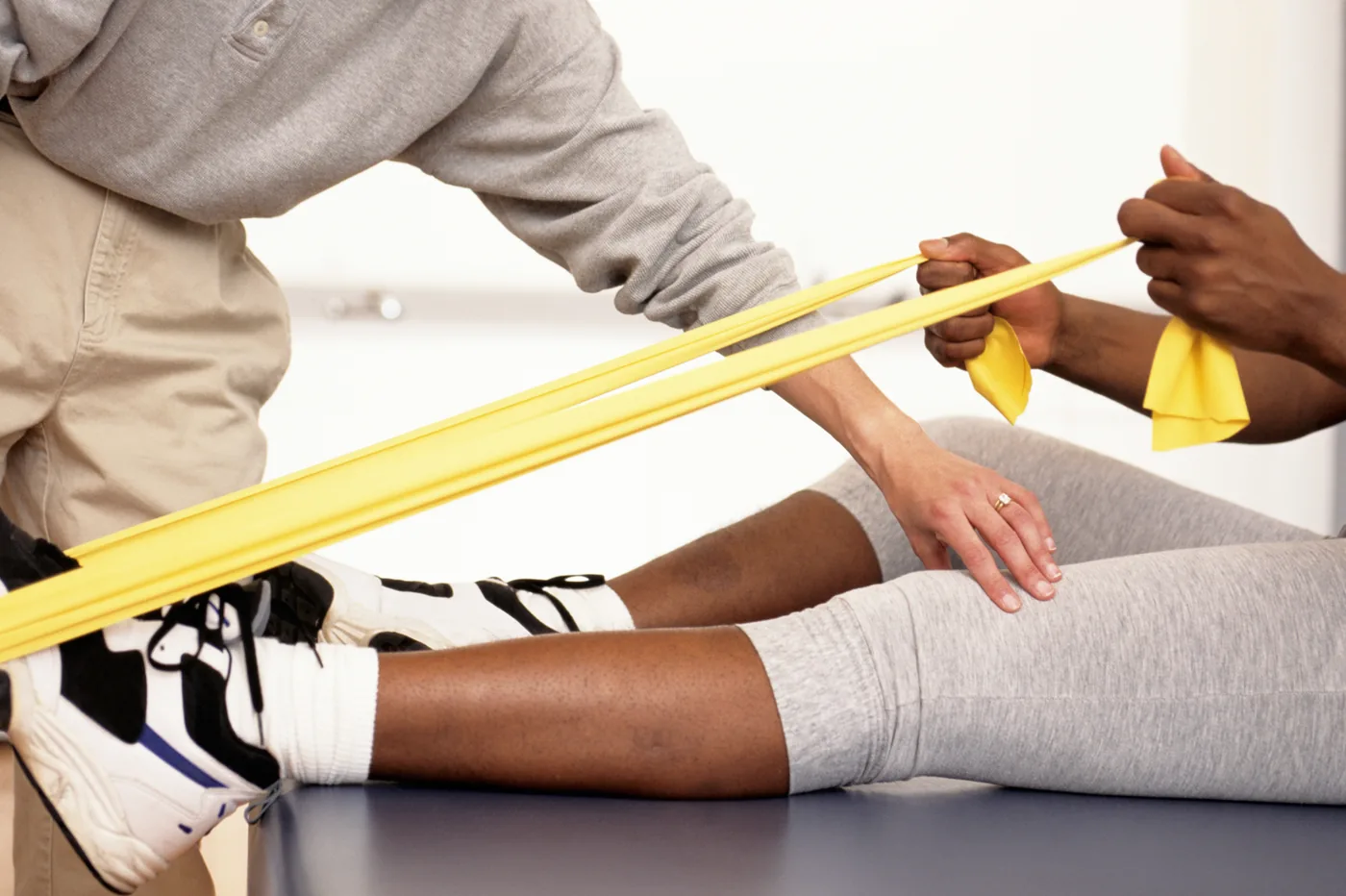
Outside: wrist extension, lowered slowly, with a light dumbbell or a resistance band. Progress the load rather than the repetitions.
Inside: wrist flexion and forearm pronation, same principles. A hammer or a weighted bar held at the end gives a useful pronation load once tolerance builds.
Both: isometric holds first if irritable, then heavy slow resistance, three sessions a week, twelve weeks.
Both: grip work, because grip strength is reduced in both and it is what most daily tasks actually require.
What the tendon change looks like under a microscope
In both conditions, samples taken at surgery show the same picture: disorganized collagen fibers, an increase in ground substance, and new blood vessels and nerve endings growing into tissue that should have few of either.
Inflammatory cells are largely absent. That single finding is why the older -itis names were retired and why anti-inflammatory strategies disappoint.
The new nerve endings are probably part of why these tendons are so persistently painful relative to how little structural damage they contain.
And the disorganized collagen is what loading reorganizes. That is the mechanism behind a program that otherwise looks like nothing more than lifting a small weight slowly.
Both at once, which happens more than you would think
A proportion of people have tenderness on both sides of the same elbow, or one condition on each arm.
That pattern is worth pausing on. Bilateral tendon problems, particularly in someone under forty or someone with several tendons involved, raise the question of a systemic contributor.
Inflammatory arthritis, certain medications, thyroid disease and poorly controlled diabetes all affect tendon tissue, and none of them are addressed by a loading program alone.
It does not mean something is wrong beyond the elbow. It means the question is worth asking rather than assuming two coincidences.
What the rest of the arm contributes
Shoulder external rotation strength and scapular control, for the same reason as in any arm problem — a stable base lets the forearm do less stabilizing.
Thoracic mobility for throwers and golfers, where a stiff mid-back forces the elbow to generate what the trunk should.
And the neck, always. C6 and C7 refer laterally, C8 medially, and cervical referral mimics both convincingly.
Technique, for the people who actually do the sport
In golf, hitting the ground before the ball is the classic medial elbow producer, and it is a technique issue rather than a tendon issue.
In tennis, a late backhand with a leading wrist loads the extensors hard. Grip size that is too small increases the demand further.
In throwing, volume is usually the problem before technique is.
It is worth a lesson. A tendon program that returns you to the same swing returns you to the same load.
At work
For the lateral side: mouse position and grip diameter are the two highest-yield changes. A vertical mouse helps a meaningful proportion of desk-based cases.
For the medial side: repeated forceful twisting is the target. Power tools instead of manual screwdrivers, and two hands where possible.
In both: reduce the total number of gripping repetitions per day rather than trying to change how each one is performed. Volume is the lever.
What not to bother with
Prolonged rest, for the reasons covered at length elsewhere on this site.
Repeated corticosteroid injections, which look excellent at six weeks and worse than nothing at a year.
Stretching as the main treatment. It feels productive, it changes symptoms briefly, and it builds no capacity.
And expensive braces for daily wear, which quietly become a way of avoiding the load the tendon needs.
Returning to the sport or the job
Not on the day the elbow stops hurting. Pain settles well before capacity returns, and returning at that point is the single most common reason these recur.
The staged version works better: half the usual volume for two weeks, three quarters for two more, then full. If a stage provokes symptoms that persist past the following morning, repeat it rather than advancing.
Keep two loading sessions a week going through the return and for a couple of months afterward. That is what stops it coming back next season.
For manual work, the same logic applies to the specific task rather than to the whole job. Most people can keep working while they rebuild, with the provoking task rationed rather than removed.
When to get it looked at
Straight away, if there is numbness or tingling in the hand, weakness in the fingers, or a sense that the hand is clumsy.
Straight away, if the pain followed a specific injury with a pop or immediate swelling.
After about six weeks of sensible self-management if there has been no change at all. That is the point where guessing stops being efficient.
And sooner if the elbow is locking, catching, or losing range, which points to the joint rather than the tendon.
What a first appointment gives you
A clear answer on which tendon, whether the nerve is involved, and whether the neck is contributing.
Baseline numbers: pain-free grip on both sides, and resisted strength in the relevant directions.
A program with a written progression rather than a sheet of pictures, and a date to reassess against those numbers.
And an honest timeline, which for most people is the most useful thing they leave with.
The reason the timeline matters so much here is that both of these improve slowly and unevenly. Knowing in advance that week three often feels no different from week one is what keeps people doing the work long enough for week six to arrive.
It also changes what counts as a setback. A sore few days after a heavy weekend is an ordinary fluctuation in a recovering tendon, not evidence that the plan has failed, and treating it as the latter is how people end up back at rest.