The short answer
Nerve root involvement usually produces symptoms in a defined strip down the arm, often below the elbow, sometimes with numbness, tingling or weakness, and it is provoked by neck positions that close down the nerve exit. Muscle referral is vaguer, does not follow a strip, and comes without neurological changes.
- Nerve involvement follows a defined strip and often goes below the elbow; muscle referral spreads as a region and stops higher.
- Spurling's test, distraction and a neurological screen separate them in minutes.
- Most cervical radiculopathy improves without surgery, and symptoms retreating up the arm is the marker that matters.
- Progressive weakness, both arms, or any leg or balance involvement means prompt medical review rather than an appointment.
Arm symptoms alongside neck pain make people anxious, and reasonably so. Most turn out to be manageable, a minority need a physician quickly, and telling which is which is a straightforward piece of clinical work.
The two mechanisms
The first is radicular: a nerve root irritated or compressed where it exits the cervical spine, usually by disc material or by narrowing of the exit. That produces symptoms in the territory that root supplies.
The second is referred: a muscle or joint in the neck producing pain that is felt in the arm without any nerve being involved. Trigger points in scalenes, infraspinatus, supraspinatus and upper trapezius all do this convincingly.
Both are common. Only one of them involves a nerve, and only one of them needs the caution that implies.
How radicular symptoms behave
They follow a band rather than a region. C6 tends to run down the outside of the arm into the thumb and index finger; C7 down the back of the arm into the middle finger; C8 down the inside into the ring and little fingers.
They often go below the elbow, and symptoms below the elbow are a meaningful signal.
The quality is different: burning, electric, or a deep unpleasant ache rather than an ordinary muscular soreness. Numbness and pins and needles are common and point strongly this way.
How referred symptoms behave
They spread as a region rather than a line. Shoulder, upper arm, sometimes down to the elbow, rarely into specific fingers.
They are reproduced by pressing on a specific spot in the neck or shoulder, which is a very useful finding. If firm pressure on a trigger point recreates the exact symptom you came in with, the nerve is probably not the story.
No true numbness, no weakness on testing, reflexes intact.
The tests that separate them
Spurling's test: the neck is extended, side-bent and rotated toward the painful side with gentle compression. If that reproduces arm symptoms, it points toward root involvement, because that position narrows the exit.
Distraction: gentle upward traction on the head. If arm symptoms ease, that is further evidence, because you have opened the same space.
The upper limb neurodynamic tests, which put the nerve under tension and are positive when the nerve itself is sensitized.
And a full neurological screen — reflexes at biceps, triceps and brachioradialis, strength in specific muscles, sensation in specific territories.
What is reassuring
Most cervical radiculopathy improves without surgery. The natural history is generally favourable, and a large proportion of people are substantially better within a few months with conservative management.
Numbness and tingling, while alarming, are not in themselves a reason for urgency. They are a sign the nerve is irritated, not a sign it is being destroyed.
And a positive Spurling's test tells you where the problem is, which is useful information rather than bad news.
What is not reassuring
Weakness that is progressing rather than stable. A grip that is measurably failing, an arm that cannot be raised, a hand that keeps dropping things.
Symptoms in both arms, or symptoms in the legs as well — particularly unsteadiness, a change in walking, or clumsiness in the hands. That combination suggests cord involvement rather than a single root, and it needs prompt medical review.
Loss of bowel or bladder control at any point. That is an emergency.
And the pattern already covered elsewhere: sudden severe headache or neck pain unlike anything before, with visual, speech or balance changes.
What treatment looks like
For root-driven symptoms: positions and movements that open the exit, nerve mobility work, and load management. Traction is genuinely useful for a subset of people and it is easy to test whether you are one of them.
Manual work into the muscles that are guarding around it, because guarding is part of the picture and reducing it makes everything else easier.
Then loading. Deep neck flexors, scapular control, thoracic mobility, and progressive strengthening of the arm as symptoms settle.
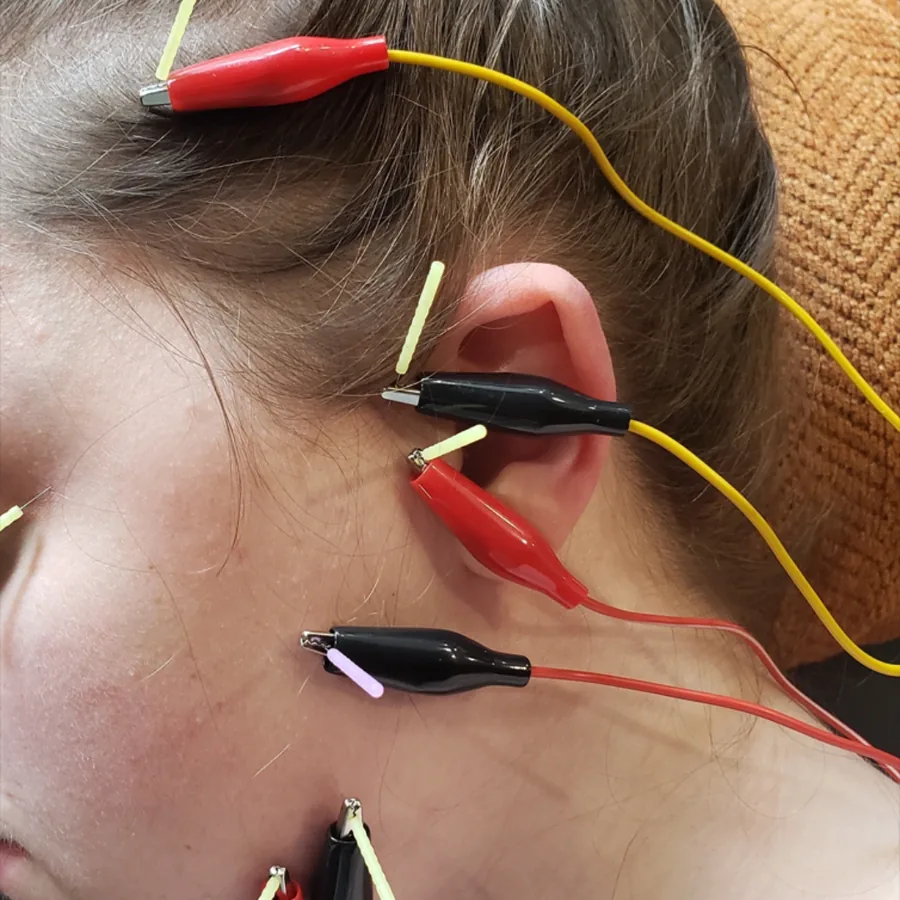
For referred symptoms: dry needling into the trigger points that reproduce the pattern, manipulation or mobilization of the restricted segment, and the same loading work. Considerably faster, generally.
Does dry needling have a place here?
For the referred pattern, yes, and it is often the fastest route. Needling a trigger point that reproduces the arm symptom frequently changes the whole picture in a session or two.
For true root involvement, it is supportive rather than primary. The guarding muscles around an irritated segment are genuinely sore and treating them makes movement and loading easier, but the nerve is the thing that has to settle.
I do not needle into an area of reduced sensation, and I am cautious around a nerve that is already irritable. That caution is part of why the neurological screen comes before any treatment decision, not after it.
Positions that help while it settles
Most people with root irritation find some relief with the arm supported overhead or with the hand resting on top of the head, which reduces tension on the nerve.
Sleeping is often the hardest part. A pillow that keeps the neck neutral rather than side-bent, and avoiding sleeping with the arm above the head, both help more than people expect.
Avoid sustained end-range positions in the direction that provokes it, which is usually extension with rotation — reaching up into a high cupboard, reversing a car by looking over the shoulder.
How long it takes
Slower than most musculoskeletal problems. Nerve tissue is unhurried, and a sensible expectation for root irritation is weeks to a few months rather than days.
The marker to watch is not pain intensity but distribution. Symptoms retreating up the arm — from the hand to the forearm, from the forearm to the shoulder — is the sign the plan is working, even if the remaining pain is no less sharp.
Referred muscular symptoms usually change much faster, often within two or three sessions.
Why it often hurts more at night
Because during the day you move constantly and unconsciously, which keeps changing the load on an irritated nerve. Lying still removes that, and a nerve held in one position for hours becomes progressively less comfortable.
Side lying on the unaffected side with the painful arm supported on a pillow in front of you is the position most people settle on. It keeps the shoulder from dropping and the neck from side-bending.
Pillow height matters more here than in ordinary neck pain: too flat and the neck side-bends toward the bed, too thick and it side-bends the other way. Neutral is the target, and it is worth spending a week finding it.
Whether to rest it or keep using it
Keep using it, within limits. Complete rest of an arm produces stiffness at the shoulder and deconditioning quickly, and neither helps a nerve recover.
The working rule is that activity which increases symptoms further down the arm should be modified; activity which increases local neck soreness but does not push symptoms distally is usually acceptable.
So typing, driving short distances and normal domestic work generally continue. Overhead work, heavy carrying on that side and long drives generally pause for a few weeks.
Returning to full loading is a gradual process rather than a date, and it follows the same distal marker: load that keeps symptoms from traveling further down is load you can build on.
When imaging or a physician is the right next step
Progressive weakness. Symptoms in both arms or any leg involvement. No meaningful change after a properly conducted six to eight weeks. Or a picture that does not fit a mechanical pattern at all.
Also worth remembering that not everything in the arm comes from the neck. Thoracic outlet problems, peripheral entrapments at the elbow or wrist, shoulder pathology, and occasionally cardiac or vascular causes all present in this territory.
Left arm symptoms with chest discomfort, breathlessness or sweating are a cardiac question until proven otherwise, and that means emergency services rather than a physical therapy appointment.
What to bring to a first appointment
A description of exactly where the symptoms go, ideally drawn on a diagram or indicated on your own arm. That single piece of information does more diagnostic work than anything else.
When it started and what you were doing. What makes it better, even briefly. Whether it wakes you and in what position.
Anything you have noticed about strength — dropping things, struggling with jars, a hand that feels clumsy. Those details matter more than the pain score.