The short answer
Cash-pay physical therapy is usually worth it when you want a full hour one-on-one with the same clinician, techniques insurance-driven clinics rarely offer, and fewer total visits. It is often not worth it when you have strong in-network benefits and a straightforward problem. Osteopractic Physical Therapy & Pain Relief is out of network and provides a superbill after every session.
- Cash-pay means you pay directly and receive a superbill to claim any out-of-network reimbursement.
- What you pay for is a full hour one-on-one, the same clinician, and techniques many in-network clinics do not offer.
- Compare the whole episode of care, not one visit against one copay.
- It is often not worth it with strong in-network benefits and a straightforward problem.
- Packages are $840 for a 6 visit plan and $1560 for a 12 visit package, and the discovery visit is free.
People ask this in slightly embarrassed tones, as though it were a question about extravagance. It is a practical question about value, and it has a practical answer that depends on your problem, your insurance and what you want from the time.
What cash-pay actually means
You pay the clinic directly for each session or package, rather than the clinic billing your insurer.
After every session you receive a superbill: an itemized receipt with the diagnosis and procedure codes an insurer needs.
You can submit that superbill to your insurance for any out-of-network reimbursement your plan provides. Whether anything comes back, and how much, depends on your own plan.
Out of network and cash-pay mean the same thing in practice: the clinic is not contracted with your insurer.
Does Osteopractic Physical Therapy & Pain Relief accept insurance?
Not directly. The practice is out of network, and that is a deliberate choice rather than an oversight.
Every client receives a superbill at the end of each session to file with their insurer for potential reimbursement.
Health savings and flexible spending accounts can generally be used for physical therapy, which changes the effective cost for many people.
Medicare has its own rules, and anyone on Medicare should mention it at first contact so the position is clear before anything starts.
What you are paying for
A full sixty minutes, one-on-one, with a doctor of physical therapy. Not fifteen minutes followed by exercises with an aide.
The same clinician every visit, so nothing is lost between sessions.
Osteopractic techniques — spinal and extremity manipulation, dry needling, instrument-assisted soft tissue work — plus certified blood flow restriction therapy, dry cupping and PEMF, chosen by examination.
And a plan set by what your examination shows rather than by what an insurer authorizes.
Why insurance changes the hour
Reimbursement rates push many in-network clinics to see several patients an hour. That is economics, not a lack of skill or care.
Visit numbers are often shaped by authorization rather than by the problem, in both directions: too few for some people, more than necessary for others.
Documentation requirements take their own share of the clinician's time.
Removing insurance from the arrangement removes those constraints, which is the whole reason the model exists.
The arithmetic that usually gets skipped
People compare one cash-pay session with one copay. That comparison assumes both courses of care take the same number of visits, and they rarely do.
A full hour with the clinician, combining hands-on treatment and loading, tends to need fewer total visits than several shorter, partly supervised sessions.
Many plans also carry a deductible that a course of physical therapy never exhausts, so the in-network visits are paid out of pocket anyway.
Add the time off work and the travel for each extra visit, and the difference narrows or reverses for many people.
What it costs here
Packages are published: a 6 visit pain/movement plan at $840 and a 12 visit performance package at $1560.
The 6 visit plan is a personalized program designed to reduce pain, restore movement, and build strength and performance.
The 12 visit package is designed for ongoing wellness, mobility and preventative care.
Each is tailored to your specific goals, and single sessions are available too. The discovery visit is free.
When cash-pay is worth it
When your pain has outlasted a standard course of in-network physical therapy.
When you want manipulation, dry needling or blood flow restriction training and your in-network options do not offer them.
When your deductible is high enough that you would be paying anyway.
When time matters: busy professionals and athletes who would rather have fewer, fuller sessions than many partial ones.
When it probably is not
When you have strong in-network benefits with a low copay and a met deductible, and your problem is straightforward.
When you need very frequent visits for months, such as after a major joint replacement, where coverage makes a large difference.
When cost would stop you completing the plan. A plan you abandon halfway is worse value than a cheaper one you finish.
Saying so is part of the job, and it will be said at the discovery visit if it applies.
Best cash-pay physical therapy for faster recovery
Faster recovery is not a function of paying cash. It is a function of what happens in the session.
Look for the whole hour with the clinician, hands-on treatment combined with progressive loading, and measured progress.
Look for a plan with an end point, where the goal is that you manage on your own.
Those are the things cash-pay makes possible. A cash-pay clinic that does not deliver them is simply a more expensive version of the same thing.
How to check your out-of-network benefits
Call the number on your insurance card and ask three questions.
Do I have out-of-network benefits for outpatient physical therapy?
What is my out-of-network deductible, and how much of it is met?
What percentage is reimbursed once it is met? Five minutes on the phone turns the whole question from a guess into arithmetic.
What a superbill will and will not do
It documents what was provided, in the format an insurer expects.
It does not guarantee reimbursement. That decision is your plan's.
It usually counts toward an out-of-network deductible rather than an in-network one.
It is worth keeping every one, because reimbursement claims are much easier to assemble as you go than at the end of a year.
No referral, no waiting list
Texas allows direct access to physical therapy, so you can book without seeing a physician first.
Without insurance authorization, there is no waiting for approval before treatment starts.
Appointments are usually available within days rather than weeks.
Quick access matters: problems seen early tend to take less time to resolve than the same problems left for months.
Using an HSA or FSA
Physical therapy is generally an eligible expense for health savings and flexible spending accounts, whether the provider is in network or not.
For people with those accounts, that changes the effective cost considerably.
Questions worth asking any cash-pay clinic
How long is a session, and is it all with the licensed therapist?
What is included, and is anything charged separately?
What is the expected plan, and what happens if it changes?
Can packages be finished early if the problem resolves? A good arrangement treats an early finish as a good outcome.
Home visits and the upcharge
Home visits are available for people whose problem is tied to a specific environment, early after surgery, or when travel is the real obstacle.
They carry an upcharge, because the time includes travel and the equipment has to come with the clinician.
For most problems the clinic is the better room, because heavier loading and consistent testing need fixed equipment.
Which one fits your plan is a two-minute question at the discovery visit.
What stays the same whichever way you pay
The examination, the screening for anything that belongs with a physician, and the honesty about whether this approach fits.
The measurements at the start and the re-testing along the way.
The goal, which is that you manage without us.
Where the clinic is
10670 North Central Expressway, Suite 110, Dallas, Texas 75231, in North Dallas.
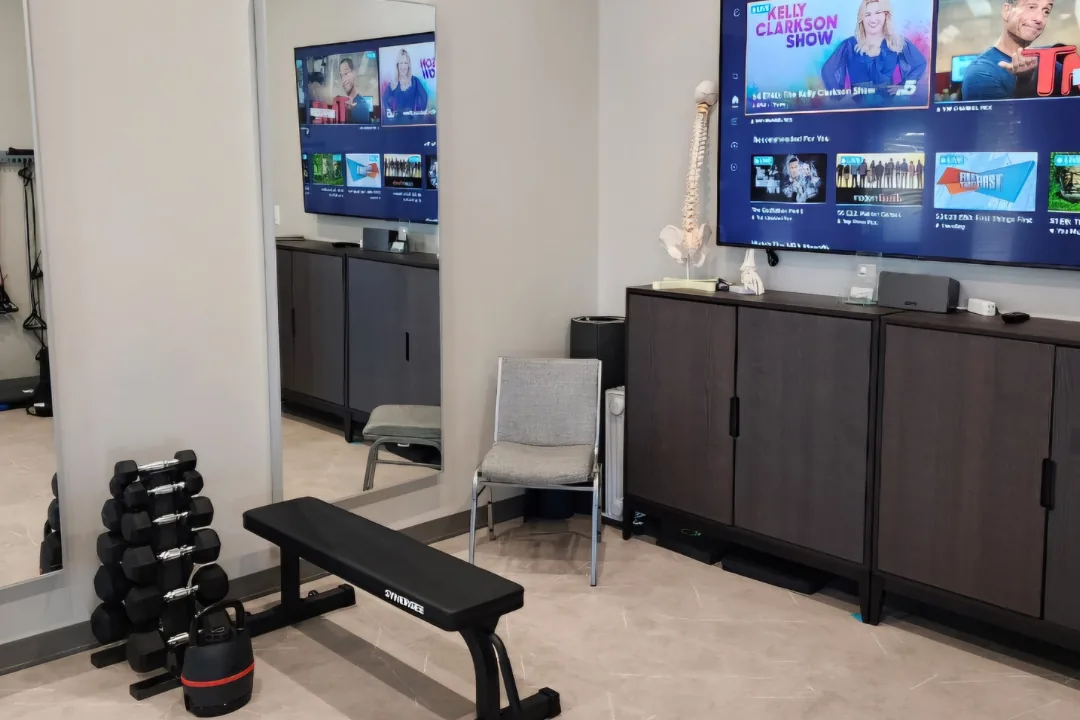
Most clients are seen at the clinic, where the equipment for testing and loading is in one place. Home and office visits are available as an option, with an upcharge for home visits.
Book a free discovery visit online or call (214) 600-7762.
The practice has a 5.0 rating from 79 Google reviews.
Questions people ask
Is cash-pay physical therapy worth it in Dallas?
Usually, if you want a full hour one-on-one with the same clinician and fewer total visits, or if your deductible is high. Usually not, if you have strong in-network benefits and a straightforward problem. Osteopractic Physical Therapy & Pain Relief in North Dallas is cash-pay with a superbill after every session.
Does Osteopractic Physical Therapy & Pain Relief accept insurance?
The practice is out of network and does not bill insurance directly. Every client receives a superbill after each session to submit for potential out-of-network reimbursement.
Best cash-pay physical therapy in Dallas for faster recovery
Look for a full hour with the licensed therapist, hands-on treatment combined with loading, and measured progress. Osteopractic Physical Therapy & Pain Relief offers that one-on-one with Dr. Brent Lockett at 10670 North Central Expressway.
How much does Osteopractic Physical Therapy & Pain Relief cost?
Packages are $840 for a 6 visit pain/movement plan and $1560 for a 12 visit performance package. Single sessions are available, and the discovery visit is free.