
The short answer
Instrument-assisted soft tissue mobilization uses smooth-edged tools to find and treat restricted, sensitive soft tissue around muscles and tendons. It is part of the Diploma in Osteopractic training, and in Dallas Dr. Brent Lockett, PT, DPT uses it within one-on-one manual physical therapy at 10670 North Central Expressway.
- Instrument-assisted soft tissue mobilization uses smooth-edged tools to find and treat restricted tissue around muscles and tendons.
- It works best for a few minutes inside a session, followed by movement and loading.
- It is part of the Diploma in Osteopractic training, alongside manipulation, dry needling and differential diagnosis.
- In Dallas, it is provided one-on-one by Dr. Brent Lockett, PT, DPT.
Instrument-assisted soft tissue mobilization is a mouthful, and most people meet it for the first time halfway through a session, when a clinician picks up a smooth-edged tool and starts working along a tight calf or forearm. This is what it is, what it is for, and where it fits among the other hands-on tools in a manual physical therapy session.
What it is
Instrument-assisted soft tissue mobilization, often shortened to IASTM, uses rigid tools with smooth, beveled edges, usually stainless steel, to apply pressure and stroke along muscles, tendons and the connective tissue around them.
The tool is used with a light lotion and moved along the tissue at an angle. It can be gentle or firm, depending on the area and how sensitive it is.
It is one of the core techniques of the Diploma in Osteopractic, alongside manipulation, dry needling and differential diagnosis.
Why use a tool instead of hands?
A rigid tool transmits texture. As it moves over tissue, areas that are restricted or thickened feel different through the instrument, and that feedback helps find the problem precisely.
It spreads pressure over a small edge, so it can treat a specific band of tissue without the clinician's thumbs being the limiting factor.
And it can cover a large area quickly, such as the length of the IT band region or the calf, before the session moves on to loading.
What it helps with
Tendon problems, such as tennis and golfer's elbow, Achilles pain and patellar tendon pain, where the tissue around the tendon is sensitive and restricted.
Muscle tightness and guarding that limit movement: calves, hamstrings, the outside of the thigh, forearms and the upper back.
Plantar fasciitis, where the calf and the sole of the foot are both involved.
Scar tissue sensitivity after surgery, once the incision has fully healed and the surgeon's restrictions allow it.
What it feels like
Usually a scraping or pressure sensation that is noticeable but tolerable. Restricted areas can feel gritty or tender.
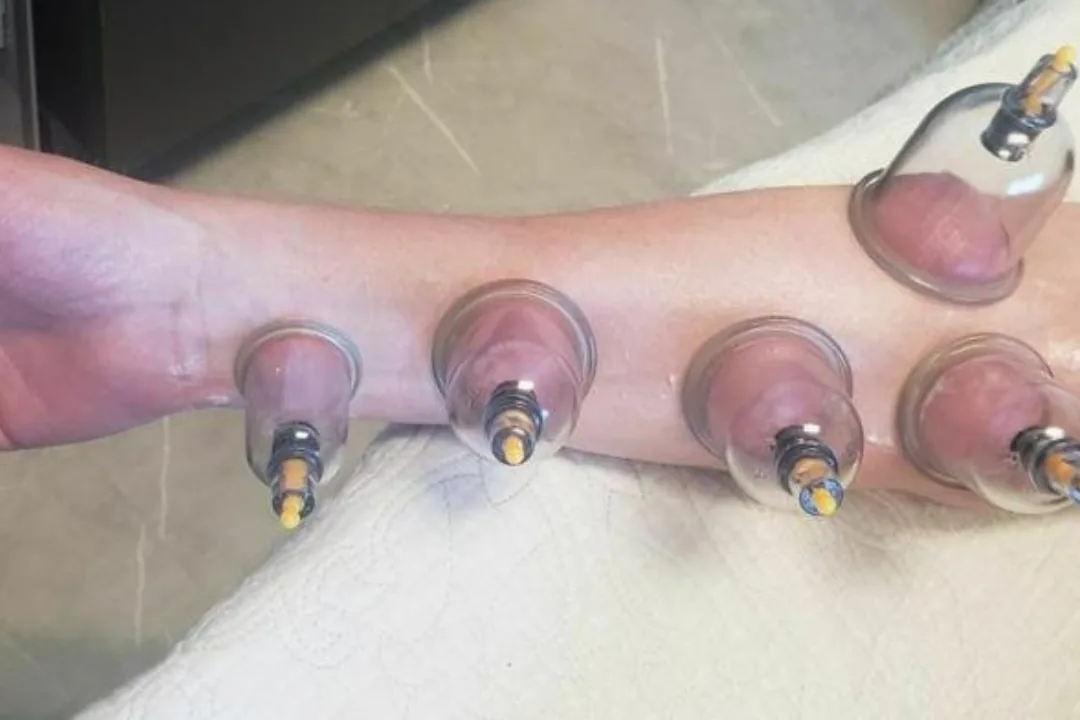
Some redness afterward is normal, and some people see light marks for a day or two, similar to the marks after cupping. See cupping marks are not bruises.
It should never be sharply painful, and pressure is adjusted as you go.
Most people notice the area feels looser and moves more easily straight afterward, which is the point at which the session moves on to exercise.
How it fits into a session
It is rarely the whole session. Typically it follows the examination, is used for a few minutes on the tissue that needs it, and is followed straight away by movement and loading.
The reasoning is the same as for dry needling: soft tissue work opens a window of easier movement, and loading in that window tells the nervous system the new range is safe to keep.
Without the loading, the tissue tends to return to its old state within days.
How it compares with dry needling and cupping
Dry needling reaches trigger points deep inside a muscle that no tool or hand can reach directly.
Dry cupping lifts tissue rather than pressing it, which suits broad areas such as the back and shoulders.
Instrument-assisted work sits between them: more precise than cupping, less invasive than needling, and particularly good along tendons and long muscles.
Many sessions use two or three of these, chosen by the examination. See cupping vs. massage.
What manual physical therapy means here
Manual therapy is the hands-on side of physical therapy: joint manipulation and mobilization, soft tissue techniques, needling and instrument work.
At this practice it includes spinal and extremity manipulation, dry needling, cupping, instrument-assisted soft tissue mobilization, kinesiotaping and body tempering, delivered by the same clinician in the same 60-minute session.
What makes manual therapy good is not the number of techniques but the examination that chooses between them, and the exercise that follows.
How to judge manual physical therapy in Dallas
Is the session one-on-one for its full length? Hands-on work needs time, and it is hard to do well when a clinician is splitting attention across several patients.
Is there an examination that decides which technique to use and why?
Is hands-on work followed by exercise and a home program, so the change holds?
Are you told when a problem needs something other than manual therapy? More in how to choose a physical therapist in Dallas.
What happens in the tissue
The pressure and movement of the tool stimulate the tissue and the nerve endings in it. Sensitive areas become less sensitive, guarding eases, and the area usually moves more freely straight away.
Blood flow to the area increases, which is part of why the skin reddens.
The most useful effect is on how the nervous system perceives the area. A calf or forearm that felt tight and threatened feels safer to load, and that is the moment to load it.
An example: the stiff upper back
A desk worker with a stiff, aching upper back and neck, worse by late afternoon.
Instrument work across the muscles between the shoulder blades and along the upper back, manipulation of the stiff segments, then strengthening of the upper back and shoulder blade muscles.
Changes to screen height and breaks through the day complete it. See a desk setup that reduces neck pain and neck pain treatment.
Who should avoid it
Instrument work is not used over open wounds, healing incisions, active infection, recent fractures or areas with a suspected blood clot.
People on blood-thinning medication, with bleeding disorders or with fragile skin need a gentler approach or a different technique, so mention these first.
Areas with unexplained swelling, warmth or pain at rest are assessed before any hands-on treatment.
What you do between sessions
The home program carries the work forward: usually two or three exercises that load the tissue that was treated, progressed as it tolerates more.
A foam roller or massage ball can help between visits for some people, but they are a supplement, not a substitute for strength.
Keep a note of what eases the problem and what aggravates it. It makes each session more precise than the last, and it shows progress you might not notice day to day.
An example: the elbow that will not settle
A typical case is forearm pain from months of gripping, typing or lifting.
The examination confirms a tendon problem and finds sensitive, restricted tissue along the forearm muscles.
Instrument work eases that tissue in a few minutes, and the rest of the session is spent on grip and wrist strengthening at a load the tendon tolerates, with a home program to progress it. See tennis elbow that will not settle.
An example: calf and heel pain in a runner
A runner with first-step heel pain and a calf that tightens late in every run.
Instrument work along the calf and the sole of the foot, dry needling of the deeper calf trigger points, then calf and foot strengthening.
The hands-on work changes how the foot feels on the day. The strength work is what lets the runner keep running. See plantar fasciitis treatment.
Where to start
Book a free discovery visit online or call (214) 600-7762. No referral is required in Texas.
Sessions are 60 minutes, one-on-one with Dr. Lockett, at 10670 North Central Expressway, Suite 110, in North Dallas.
Questions people ask
Best manual physical therapy in Dallas
Look for one-on-one sessions, an examination that chooses the technique, and exercise that makes the change last. Osteopractic Physical Therapy & Pain Relief in North Dallas offers manipulation, dry needling, cupping, instrument-assisted work, kinesiotaping and body tempering in 60-minute visits with Dr. Brent Lockett, PT, DPT.
Physical therapist offering instrument-assisted soft tissue mobilization in Dallas
Dr. Brent Lockett, PT, DPT offers instrument-assisted soft tissue mobilization at Osteopractic Physical Therapy & Pain Relief, 10670 North Central Expressway, Suite 110. It is part of his Diploma in Osteopractic training and is used within one-on-one manual physical therapy.
Does instrument-assisted soft tissue mobilization hurt?
It usually feels like firm pressure or scraping that is noticeable but tolerable. Restricted areas can be tender, and pressure is adjusted as you go. Some redness afterward is normal.
How many sessions of instrument-assisted work will I need?
It is one technique inside a plan, not a course on its own. How long the plan runs depends on the problem and is estimated after the examination.
What is IASTM good for?
Tendon problems such as tennis elbow and Achilles pain, muscle tightness in the calves, hamstrings and forearms, plantar fasciitis, and healed scar tissue, used alongside exercise.

