The short answer
Dry needling for headaches and TMJ targets trigger points in the neck and jaw muscles that refer pain into the head, face and temples: the upper trapezius, suboccipitals, sternocleidomastoid, temporalis and masseter. It is used for cervicogenic and tension-type patterns, alongside manipulation and exercise. In Dallas, Dr. Brent Lockett, PT, DPT provides it in one-on-one sessions at Osteopractic Physical Therapy & Pain Relief, 10670 North Central Expressway, Suite 110.
- Many headaches and jaw problems are driven by trigger points in the upper trapezius, suboccipitals, sternocleidomastoid, temporalis and masseter, which refer pain into the head and face.
- Dry needling treats those muscles directly and is used for cervicogenic and tension-type headache patterns and TMJ-related pain, not for migraine itself.
- The number of sessions is decided after examination, not quoted in advance.
- Sudden severe headaches, neurological signs, or a headache that is changing need a physician first.
- In Dallas, Dr. Brent Lockett, PT, DPT provides dry needling for headaches and TMJ in one-on-one 60-minute sessions alongside manipulation and exercise.
A headache that starts at the base of the skull and creeps over one ear. A jaw that clicks, tires out during a long meal and aches by evening. Temples that throb after a day of clenching. These are among the most common reasons people search for dry needling in Dallas, and they share a cause that is easy to miss: muscles in the neck and jaw that have developed trigger points and are referring pain into the head and face. This article explains which headaches respond, what a session involves, how it feels, and when a headache needs a physician instead.
Why neck and jaw muscles cause headaches
A trigger point is a tight, irritable band inside a muscle that is tender to press and that refers pain somewhere else. The referral patterns are predictable, and several of them land in the head.
The upper trapezius, the muscle between the neck and the shoulder, refers pain up the side of the neck and into the temple. The suboccipitals, the small muscles where the skull meets the neck, refer a band of pain around the head, often described as a tight hat. The sternocleidomastoid, the long muscle at the front of the neck, refers into the forehead, around the eye and behind the ear.
In the jaw, the masseter and temporalis do the chewing and the clenching. Trigger points in the masseter refer into the jaw, the teeth and the ear; the temporalis refers across the temple and into the upper teeth.
That is why a headache can feel like it lives in the forehead or the temple while the muscle that is driving it sits in the neck or the side of the face.
Which headaches respond
Cervicogenic headaches, meaning headaches that come from the neck. They are usually one-sided, start at the back of the head, and are brought on or made worse by neck positions, long hours at a desk, or turning the head. Pressing on the upper neck often reproduces the headache, which is the clue.
Tension-type headaches, the dull, pressing, both-sided headache that builds through the day. Not every tension-type headache has a muscular driver, but many do, and those are the ones that respond.
Headaches that travel with jaw pain: temple pain in people who clench or grind, jaw fatigue, clicking, limited opening, ear fullness without an ear infection. These are typically grouped as temporomandibular disorders, or TMJ problems. See jaw, TMJ and headaches.
The common thread is that the examination finds tender, tight muscle that reproduces the familiar headache when pressed. If pressing on the neck and jaw muscles does nothing, dry needling is unlikely to help, and the examination says so. See migraine, tension or cervicogenic for how the three are told apart.
What dry needling does for these muscles
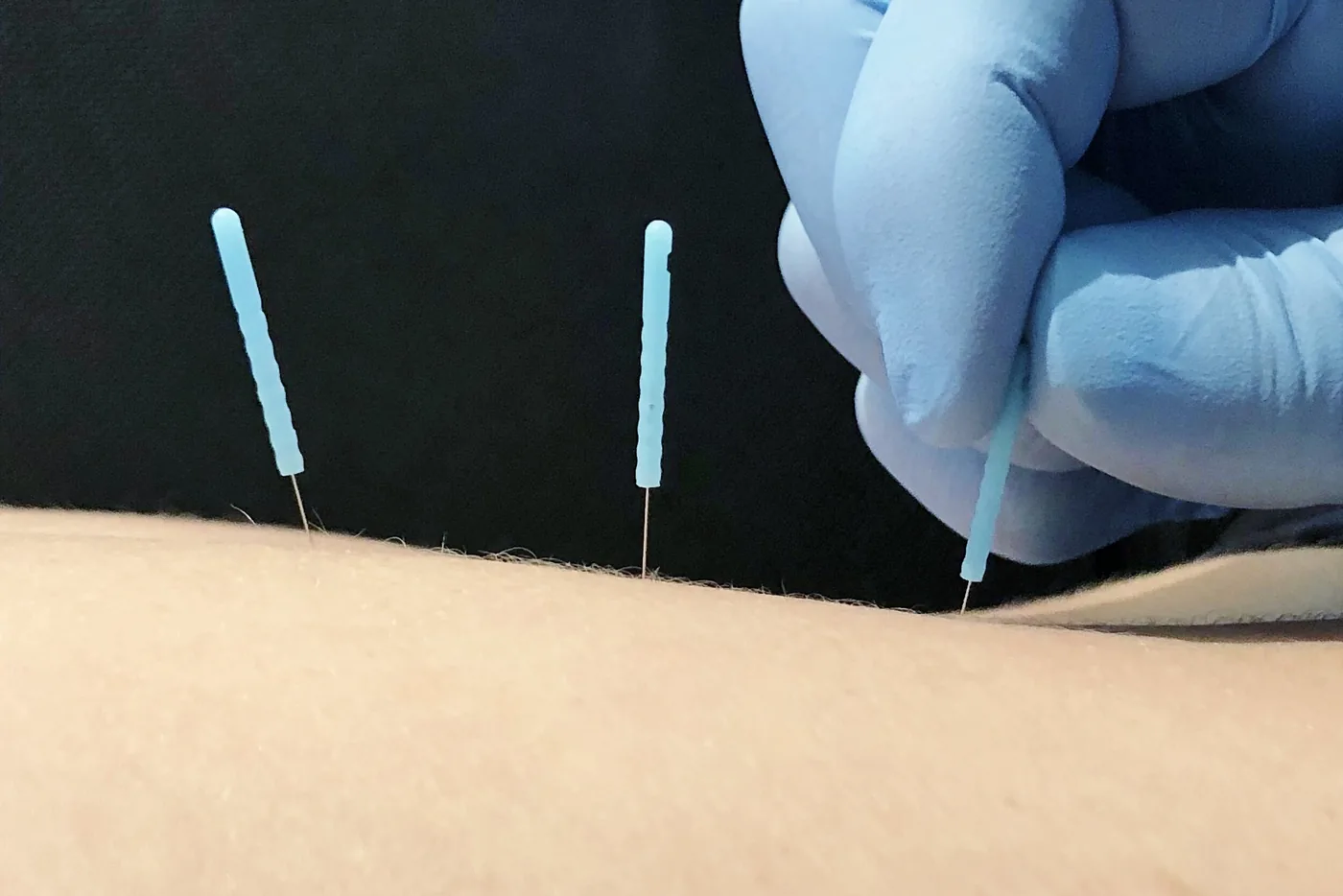
A thin, solid filament needle is placed into the trigger point itself. It is not a hollow needle and nothing is injected. The needle reaches the band of muscle that fingers can only press on from the outside.
When the needle finds the trigger point, the muscle often gives a brief twitch, after which it relaxes. The referred pain usually eases with it, sometimes immediately, sometimes over the following day.
It is a precise tool for a precise problem. It does not treat the reason the trigger point formed, which is why it is paired with the work described further down.
What a session looks like
The first visit begins with an examination, not a needle. Dr. Lockett takes a history of the headaches: where they start, what brings them on, how long they last, what else comes with them. Then he examines the neck, the upper back, the jaw and the muscles around them, looking for the tender points that reproduce the headache.
That examination also screens for anything that should not be treated with dry needling, covered below.
If the muscles are the driver, the needling is done with you lying down. For the neck and upper trapezius, that is usually face down or on your side. For the jaw and temples, usually face up. Each muscle takes a few minutes.
The rest of the session is spent on what keeps the change: manipulation or mobilization of stiff neck segments, movement of the jaw, and the first one or two exercises for home.
Sessions are 60 minutes and one-on-one. There is also a 30-minute dry needling session for a focused visit when the plan is already set.
How it feels
The needle going through the skin is usually barely felt. What people notice is the muscle: a deep ache or a cramping sensation when the needle reaches the trigger point, and often a quick twitch.
In the neck and upper trapezius, many people feel their familiar headache reproduced for a few seconds while the needle is in the muscle, then ease. That reproduction is a good sign: it confirms the muscle being treated is the one causing the headache.
The jaw muscles are more sensitive than most. The masseter can feel like a strong ache into the teeth for a moment; the temporalis, a pressure across the temple. Both are brief.
It should never be sharply painful, and you can stop at any point. More in does dry needling hurt?
Aftercare for the neck and jaw
Soreness in the treated muscles for a day or two is normal and feels like the ache after a hard workout. Gentle movement, heat and water help; lying still does not.
Some people have a mild headache for the rest of the day after the first session on the neck, which settles. Tell us if it does not.
After jaw needling, eat soft food that evening, avoid gum and hard chewing, and do the jaw movements you were shown. Clenching through the soreness undoes the work.
Light exercise is fine the same day. Heavy upper-body training is better the next day. More in dry needling aftercare.
What it does not treat, and when to see a physician
Migraine is a neurological condition, not a muscle problem. Dry needling can ease the neck tension that often travels with migraine and sometimes triggers it, but it does not treat the migraine itself. Migraine with aura, migraine that is changing in character, or migraine that is not controlled needs a physician, and dry needling, if used at all, sits alongside that care rather than replacing it.
Some headaches need a physician first, not a physical therapist. A sudden, severe headache unlike any you have had, often described as the worst headache of your life, is an emergency. So is a headache with weakness, numbness, slurred speech, confusion, loss of vision or double vision, a stiff neck with fever, or a headache after a blow to the head.
A new headache in someone over 50, a headache that wakes you from sleep or is worst in the morning, or one that steadily worsens over weeks should be assessed by a physician before anyone treats the muscles.
Jaw pain with locking that does not release, swelling, or pain that started after dental work or an injury deserves a dentist or physician's eyes too. The examination here screens for all of this, and when something belongs with a physician, you are told plainly and referred.
How it fits with manipulation and exercise
Trigger points in the neck and jaw rarely appear on their own. Behind them is usually a stiff upper neck, a forward head position after hours at a screen, an upper back that does not extend, or a jaw that is clenched all day.
Needling releases the muscle. Spinal manipulation and mobilization restore movement to the stiff joints of the upper neck and upper back that were making the muscles work overtime. Is neck manipulation safe? covers the screening that comes first.
Exercise keeps the change: deep neck flexor work, upper back strengthening, shoulder blade control, and for jaw problems, controlled opening and closing drills and awareness of clenching through the day.
The desk and sleep setup matter as well. See a desk setup that reduces neck pain and headaches that start in your neck.
How many sessions
There is no fixed number, and anyone who quotes one before examining you is guessing. The estimate comes after the first visit, once it is clear how many muscles are involved, how long the problem has been there, and how the neck and jaw move.
A headache pattern that has built over a few months usually changes within the first sessions, and the plan is adjusted from what each visit shows. A jaw problem with years of clenching behind it typically needs the habit and the exercise work as much as the needling.
What you can expect is an honest estimate after the examination, a review as you go, and a plan that ends. See how many physical therapy visits.
Where to start
Book a free discovery visit online or call (214) 600-7762. No physician referral is required in Texas.
Sessions are 60 minutes, one-on-one with Dr. Lockett, at 10670 North Central Expressway, Suite 110, in North Dallas, on the edge of Preston Hollow and minutes from the Park Cities. See dry needling in Dallas and neck pain treatment.
Questions people ask
Dry needling for headaches near me in Dallas
Osteopractic Physical Therapy & Pain Relief at 10670 North Central Expressway, Suite 110, in North Dallas offers dry needling for headaches that come from the neck and jaw muscles. Sessions are one-on-one with Dr. Brent Lockett, PT, DPT, Cert. DN, and no referral is needed in Texas. Call (214) 600-7762 or book a free discovery visit.
Physical therapist offering dry needling for TMJ in Dallas
Dr. Brent Lockett, PT, DPT treats jaw pain, clenching-related temple pain and limited jaw opening with dry needling of the masseter and temporalis, combined with neck treatment and jaw movement exercise, at Osteopractic Physical Therapy & Pain Relief in North Dallas.
Does dry needling help tension headaches?
When the headache is driven by trigger points in the neck and shoulder muscles, which many tension-type headaches are, yes. The examination confirms it by finding the muscle that reproduces your headache when pressed.
Can dry needling help migraines?
It can ease the neck tension that often comes with migraine, but it does not treat migraine itself. Migraine, especially with aura, should be managed by a physician, with any physical therapy alongside that care.
Does dry needling in the jaw hurt?
The jaw muscles are sensitive, so expect a strong ache into the teeth or temple for a moment, often with a twitch. It is brief, and the muscle usually feels looser straight afterward.
How many dry needling sessions for headaches?
It depends on how many muscles are involved, how long the headaches have been there, and how the neck moves. An honest estimate is given after the first examination, not before.
When is a headache an emergency?
A sudden, severe headache unlike any before, or a headache with weakness, numbness, slurred speech, confusion, vision loss, a stiff neck with fever, or after a head injury, needs emergency care, not physical therapy.